Pay-per-call marketing is an effective way for businesses to acquire qualified leads to generate conversions. Among the key strengths of pay-per-call marketing is that it is performance-based. You'll only pay for qualified calls for people currently in the market for your products or services. Here, we'll discuss pay-per-call, how it works, the best pay-per-call strategies, and the benefits of lead distribution software.

What is Pay-Per-Call Marketing?
As stated above, the pay-per-call marketing model involves purchasing qualified leads from lead-generation agencies. Because you only pay for qualified leads, conversion rates will increase.
How Pay-Per-Call Marketing Works
You'll work with pay-per-call publishers to identify your target audience and establish the goals of your campaign. The publishers create trackable ads with your contact information designed to attract your ideal prospects. Calls from customers responding to the ads are forwarded directly to you. Call compensation is based on the parameters you establish with the publisher. The call's length and the lead's quality are two of the most common.
Pay-Per-Call Marketing Key Benefits
Because pay-per-call ads are explicitly targeted, respondents tend to be more engaged and primed for conversion. As a result, pay-per-call affiliate marketing tends to get better results. You'll gain higher-quality leads, which can result in better conversion rates. This delivers a greater return on the investment of your marketing dollars. Because they are targeted, paid-per-call campaigns tend to be more efficient, plus they provide you with the opportunity to deliver a better customer experience.
Higher Quality Leads
Customers responding to pay-per-call ads tend to be on the verge of making purchase decisions as they often have more immediate needs. This typically results in higher conversion rates. You'll also enjoy a diminished risk of fraudulent leads, particularly compared to pay-per-click marketing.
Greater ROI
Pay-per-call marketing's higher quality leads and better conversion rates can deliver a higher ROI than other digital marketing strategies. Moreover, you only pay for calls from real customers, eliminating wasted spending on spam, bad phone numbers, or unqualified leads.
Targeted Campaigns
You dictate data points matching those of your ideal customers, which will help ensure your ads are placed in front of the most qualified prospects. Pay-per-call marketing can also better reach mobile customers, which currently comprise the largest block of online consumers.
Better Customer Experiences
Because pay-per-call campaigns foster in-person conversations, you can determine the quality of leads firsthand. You can also get real-time conversion data to help you determine the effectiveness of a campaign and pivot if performance is weaker than anticipated. Then, you can deliver the best possible customer experience, which goes a long way toward driving conversions.

Best Pay-Per-Call Marketing Strategies
Several strategies should be used to maximize the benefit of a pay-per-call marketing campaign. These include mobile optimization and the employment of multiple channels. Focusing on high-intent keywords and implementing call and location extensions is also important. Leveraging social media and applying industry-specific strategies can also help improve the efficacy of a pay-per-call marketing campaign.
Google Call-Only Ads Strategy
Instead of relying on broad mobile search traffic, the most profitable pay-per-call lead generation relies on strictly structured Google Call-Only Ads. Because these ads only appear on devices capable of making a call, you eliminate wasted clicks from desktop browsers.
To maximize ROI, restrict your campaigns using day-parting (ad scheduling) so your ads only run during the exact hours your buyers' call centers are open and staffed. Additionally, segment your campaigns by phone number type: use localized area codes for regional services (like plumbing or HVAC) to build local trust, and toll-free numbers for national services (like mass tort legal or rehab). Pair this with exact-match bidding on high-intent, bottom-of-funnel keywords (e.g., "emergency plumber near me open now") to ensure the caller is ready to buy the moment they dial.
Native Mobile Display & Click-to-Call Widgets
High-volume pay per call services often source traffic outside of search engines by utilizing native mobile display networks. This involves placing mobile-optimized advertorials on high-traffic publisher sites.
The key to converting native traffic into billable calls is the click-to-call widget. Instead of a standard form fill, the landing page features a prominent, sticky call button. To maintain lead quality and adhere to compliance (such as TCPA guidelines), these pages must utilize user-intent validation—requiring the user to actively click a button confirming they want to speak with a representative before the device's native phone dialer is triggered.
Deploy High-Intent Keywords
Concentrating on phrases such as "near me" and "service + location" also help drive successful pay-per-call efforts. These have been proven to generate more calls from potential customers who will most likely place calls on the spot.
Apply Call Extensions and Location Extensions
Employing call extensions and location extensions makes it easier for in-market shoppers to contact you directly.
IVR Transfer Campaigns from Social Media
Generating pay-per-call leads from platforms like Facebook, TikTok, or YouTube requires a different approach since the traffic is generally lower-intent than search. If you send raw social media traffic directly to a buyer, your rejection rates will spike due to misdials or unqualified inquiries.
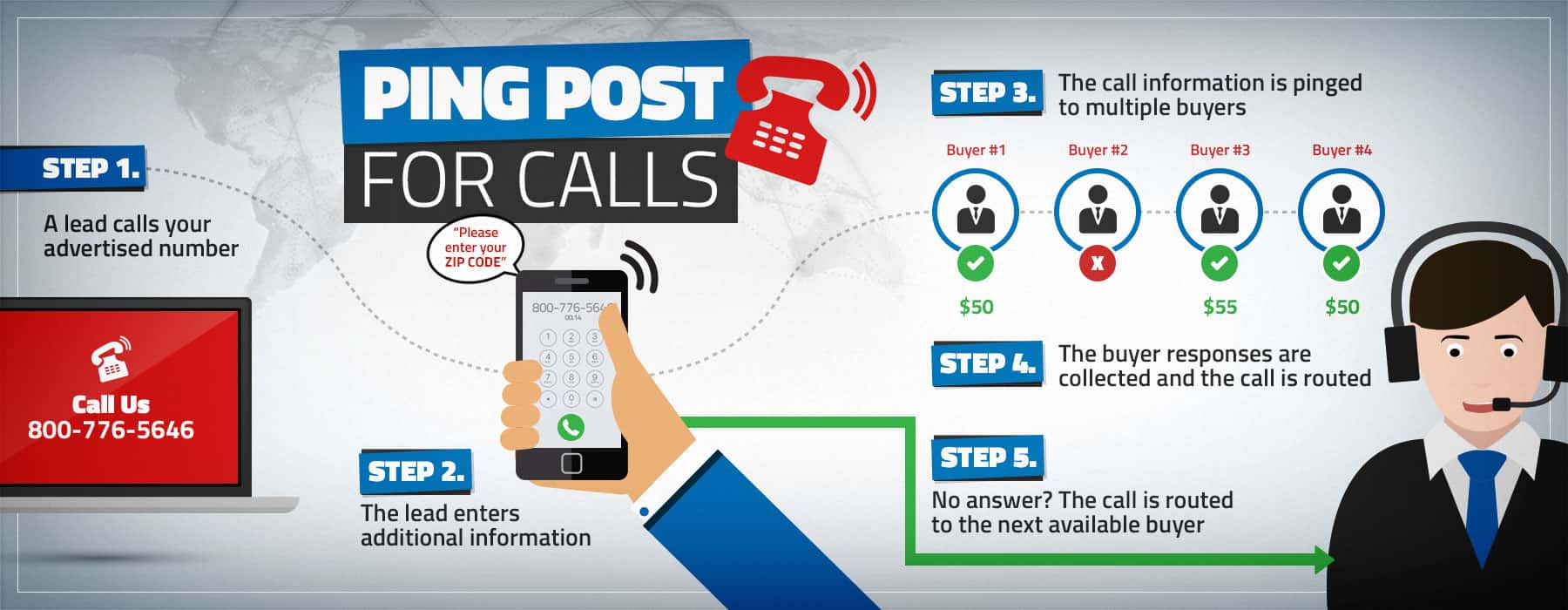
To solve this, route social media traffic through an Interactive Voice Response (IVR) tree for a warm-transfer campaign. When the prospect clicks the "Call Now" button on a Facebook ad, they don't go straight to the buyer. Instead, they hit an automated prompt (e.g., "Press 1 if you own your home, Press 2 if you rent"). This pre-qualifies the caller's intent and automatically filters out customer service inquiries or unqualified leads before dynamically routing the verified caller to the highest-bidding buyer in your network.
Industry Specific Approaches
Local targeting can strongly benefit home services like plumbing, HVACand pest control. Lawyers tend to have more success with geographical targeting and strong calls to action emphasizing the importance of immediacy to legal concerns. Whatever your industry, there is an approach designed to help you experience greater success with pay-per-call marketing.
Understanding Payout Models & Rules
In pay-per-call lead generation, generating the phone call is only half the battle; the other half is ensuring that call meets the buyer's strict payout criteria. Top-tier pay-per-call services rely on transparent rules to protect both the buyer's budget and the publisher's payout.
Billable Duration Buffers: An important metric in pay-per-call marketing is the duration buffer. Buyers do not pay for every raw call that connects to their system; they only pay for a "billable call" that meets a specific time threshold—typically 60, 90, or 120 seconds. For example, if a campaign has a 60-second buffer, the clock starts when the buyer's agent answers. If the caller hangs up or is disqualified at 59 seconds, the publisher is not paid. This buffer protects buyers from paying for misdials, voicemails, or instantly disqualified leads, ensuring they only pay for prospects engaged in a genuine sales conversation.
Repeat Caller Deduplication: To maintain lead quality, advanced campaigns implement strict deduplication rules. Lead distribution systems track the incoming Caller ID for every prospect that enters the network. If the same consumer calls back within a specified timeframe (commonly a 30-day window), the system immediately recognizes the duplicate. To maintain a seamless customer experience, the system will still route that caller directly back to the original buyer they spoke with. However, because of the deduplication rule, the buyer is not billed a second time for the same lead.
IVR Qualification Logic: To make sure buyers pay only for verified sales intent, inbound calls are often screened through an Interactive Voice Response (IVR) tree before the buyer's phone ever rings. Here is the standard logic path of an IVR filter:
- The Intent Filter: The automated system asks a qualifying question (e.g., "Press 1 for New Sales, Press 2 for Existing Customer Support"). Callers who press 2 are routed elsewhere, ensuring the buyer's lead budget isn't wasted on customer-service inquiries.
- The Demographic Filter: The system asks a required qualifying question (e.g., "Are you calling about a commercial or residential property? Press 1 for Residential").
- The Geographic Match: The caller is asked to enter their 5-digit ZIP code. The system instantly pings this against the buyer's accepted coverage areas.
- Routing & Billing: Once the caller passes the IVR prompts, the system dynamically routes them to the buyer's call center. The duration buffer clock doesn't start until the live agent picks up.
The Benefits of Lead Distribution Software
Whether yours is a one-person organization or a company generating thousands of leads daily, boberdoo lead distribution software could position you to maximize your revenue on every lead. You will save time, serve your clients better, optimize lead matching and delivery and increase your company's overall image. Traditional lead generation companies, direct marketing firms, media, advertising agencies, and advanced publishers have utilized our software to grow their businesses since 2001.
Get your free demo today.