

TLDR: For How To Sell Leads A Complete 5 Step Guide
If you want to master how to sell leads, follow these five core steps:
- Define your lead product – Choose your vertical, clarify your ideal customer, and set strong lead qualification standards so your leads match your buyers’ customer profile.
- Generate or acquire leads – Learn how to get leads consistently and focus on attracting warm leads who show real interest in your product or service.
- Build a buyer network – Connect with companies whose sales team and sales reps can convert your leads inside their sales process and sales funnel.
- Automate lead distribution – Use systems that route leads to the right buyers efficiently to maximize revenue.
- Optimize delivery and billing – Make it easy for buyers to receive leads, track performance, and scale.
When you generate sales leads that convert into potential customers, selling leads becomes a predictable, scalable revenue stream.
Learning how to sell leads can transform the way you generate revenue. Whether you already generate leads for your own company, want an additional revenue stream or plan to launch a full lead generation business, selling leads can be highly profitable when done correctly.
If you understand how to get leads, identify your ideal customer and build a repeatable sales process, you can turn interested prospects into a scalable product that businesses are willing to buy every day.
This guide walks you through, step by step, how to sell leads the right way.
How To Sell Leads
1. Define Your Lead Product
Before you can sell anything, you need to define what you're selling.
When learning how to sell leads, start by choosing your vertical (insurance, home services, legal, finance, etc.). Then determine:
- What information will you collect?
- What makes someone a qualified lead?
- Who is your ideal customer (the buyer of your leads)?
Your lead fields should support strong lead qualification. The more aligned your leads are with a buyer’s customer profile, the more valuable they become.
For example, if you generate insurance leads, your buyers (insurance agents) may require specific information to match their underwriting requirements. Strong lead qualification proves your leads show a genuine interest in your product or service, not just random inquiries.
Decide How You’ll Sell Leads
You’ll also need to determine:
- Exclusive vs. non-exclusive leads
- Pricing per lead vs. lead packages
- Weekly or monthly billing
- Real-time delivery vs. batch delivery
Clarity and transparency here makes your offer easier for buyers and their sales team to understand and trust you.
2. How To Get Leads To Sell
If you're serious about learning how to sell leads, you must master how to get leads consistently.
There are two main strategies:
Generate Your Own Leads
This is the most profitable long-term strategy. You control the marketing, the messaging, and the sales funnel.
You can generate sales leads through:
- SEO
- PPC
- Social media ads
- Landing pages
- Native ads
- Email campaigns
- Call campaigns
Your goal is to attract potential customers who show real intent. These are often considered warm leads, prospects who have actively expressed interest by filling out a form, requesting a quote or signing up for free trials.
The stronger the intent signal, the more valuable the lead.
Buying and Reselling Leads (With Added Value)
Some companies buy leads and resell them. If you take this route, you must add value. Examples include:
- Call center verification
- Live call transfers
- Data validation
- Additional filtering or segmentation
Simply flipping leads without improving quality will not build a sustainable business.
What to Avoid
Do not use scraped data, outdated email lists or cold databases. Selling cold contacts damages buyer relationships and ruins your reputation.
Selling leads requires fresh, real-time inquiries from people who have clearly expressed interest in your product or service.
3. Build Your Buyer Network
You cannot succeed in selling leads without reliable buyers.
Your buyers typically fall into two categories:
End Buyers (Retail Buyers)
These are the companies whose sales reps directly contact the leads. They use the leads inside their own sales process to convert them into customers.
Because these businesses close the deals themselves, they usually pay the highest price per lead.
Examples:
- Insurance agents
- Contractors
- Attorneys
- Solar installers
These buyers care deeply about:
- Lead quality
- Lead freshness
- Fit with their customer profile
- Conversion rates within their sales funnel
Aggregators (Wholesale Buyers)
Aggregators purchase leads and resell them to their network. They pay less, but they can provide consistent volume and broader geographic coverage.
Many successful lead sellers work with both retail buyers and aggregators to balance pricing and volume.
4. Establish Lead Distribution Logic
Step four of our "How to Sell Leads" guide requires you to select the lead distribution logic you will utilize. Real-time lead distribution used to be fairly simple, but today, new distribution logic offers several options to help you maximize profits and optimize your lead flow.
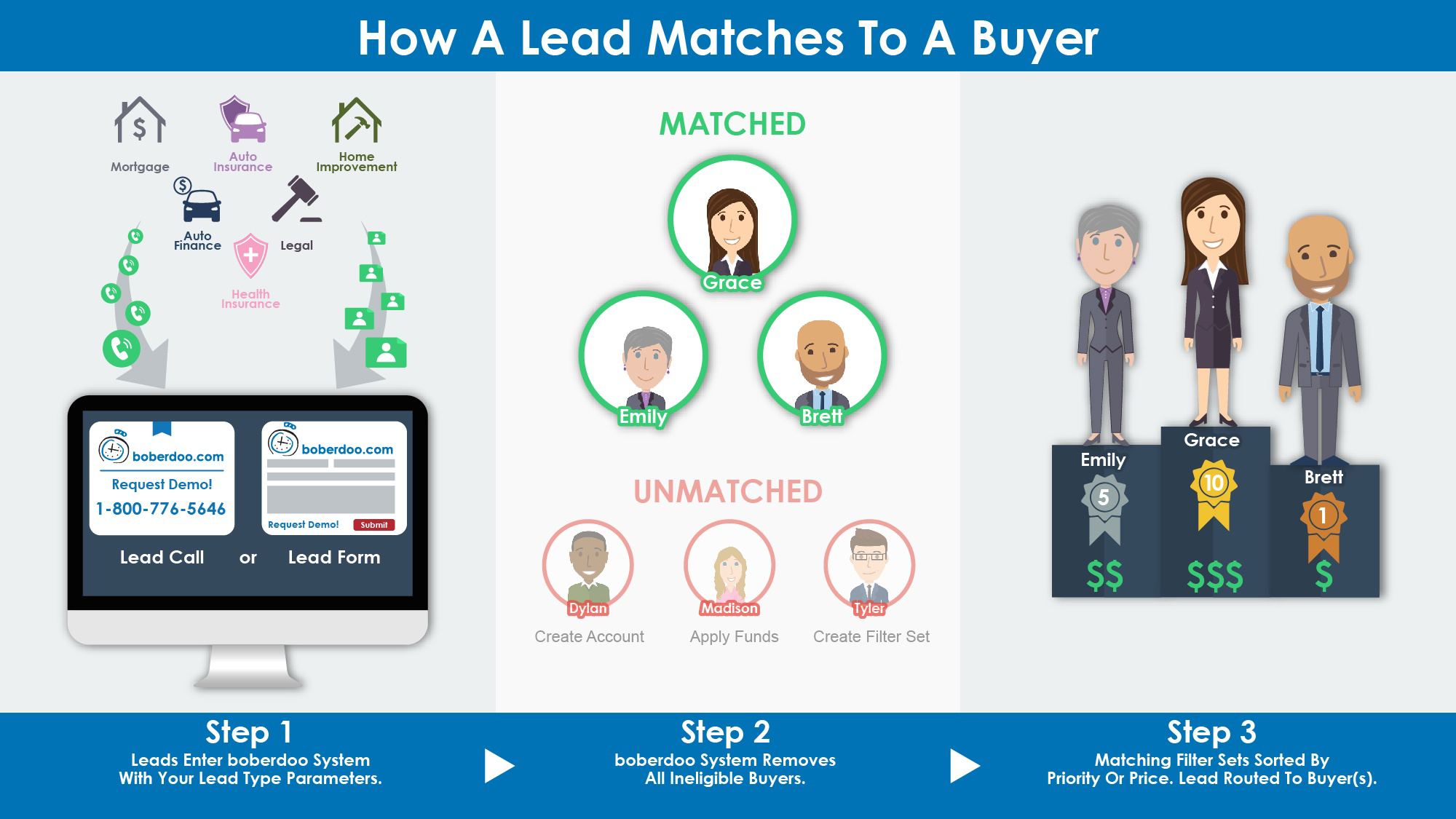
Modern lead selling requires automation. Gone are the days of spreadsheets.
A proper lead distribution system allows you to:
- Match leads to buyers based on filters
- Route leads based on geography
- Adjust pricing dynamically
- Control time-of-day delivery
- Optimize performance across your buyer network
For example, if five buyers want the same lead, your system should determine:
- Who gets it?
- At what price?
- Based on what performance criteria?
This optimization directly impacts revenue and buyer satisfaction.
To start, you can build filter sets for each of your clients that specify not only the lead fields each buyer accepts, but also the time of day/day of week they accept leads, price exceptions and more. These filter sets allow you to build custom business rules that match real-time leads to the appropriate lead buyer(s).

5. Align With the Buyer’s Sales Team
Finally, you need to establish and configure the lead purchasing options that you give to your clients. When a client purchases a lead, how can they receive this lead? Will you automatically email the lead to the client, post the lead into the client’s CRM or place the lead in a buyer portal to be retrieved at the buyer’s discretion? While most buyers provide posting specifications that allow you to automatically post every lead into their CRM or Lead Management System, you need to identify exactly what happens once a client purchases a lead.
Once your client buys a lead, how will you charge them? It is also important to set up a structured billing agreement that specifies whether you are charging for leads in real-time, sending an invoice at the end of every week or month or even launching automated re-billing on a time or trigger basis.
If you want long-term success in selling leads, you must understand how your buyers convert leads.
Ask:
- How does their sales team follow up?
- How quickly do sales reps contact new leads?
- Do they use a CRM?
- What percentage of leads become customers?
- What does their sales funnel look like?
Your success depends on their ability to convert.
High-performing buyers treat your leads like warm leads and contact them immediately. The faster the follow-up, the higher the conversion rate.
When your leads consistently generate revenue, buyers stay. But what if they're not doing what they should be on their end? You should be vetting and testing your buyers to make sure they are actually putting forth their best effort to convert, not harassing or spamming leads, and not selling leads behind your back. Especially if they start asking for refunds for good leads that they didn't convert. You can do this using seeded contacts to see exactly what communications they send out and when. Assumed is a great tool for this.
How To Sell Leads - How To Tie It All Together
To recap, here’s how to sell leads effectively:
- Define your lead product and vertical
- Build strong lead qualification standards
- Generate sales leads consistently
- Build a buyer network
- Automate lead distribution
Bonus step - Support your buyers’ sales teams
When done correctly, selling leads becomes predictable, scalable, and highly profitable.
If you already know how to generate leads, learning to sell them is simply the next step. With the right systems, buyer relationships and sales process, you can turn lead generation into a powerful standalone business.
Why Should I Start Selling My Leads?
If you’re researching how to sell leads, you’re probably wondering one thing: is it worth it?
The short answer is yes, and for many companies, learning how to sell leads becomes a major revenue driver.
Instead of charging hourly marketing fees or taking a percentage of ad spend, you generate leads and sell them as a product. This shifts your business from selling services to selling assets. With today’s real-time lead distribution technology, the infrastructure for selling leads is stronger and more accessible than ever.
If you’re considering how to sell leads as part of your business model, here are seven reasons it makes sense.
1. You Don’t Have to Change How You Market
One of the biggest advantages of learning how to sell leads is that you can keep doing what you already do well.
If you specialize in:
- PPC
- SEO
- Social media ads
- TV, radio, or direct response
- Landing page optimization
You can use those same skills to generate leads instead of managing campaigns for individual clients.
The difference? Instead of driving traffic for someone else, you drive traffic for yourself and sell the resulting leads.
2. You Turn Marketing Into a Revenue Stream
When you understand how to sell leads, you stop selling time and start selling conversions.
Relying on service clients to give you work can be unpredictable. Accounts come and go. Budgets fluctuate. Contracts end. Changes happen.
But when you generate your own leads, you always have something in demand. If the leads are high quality, buyers will consistently purchase them.
3. You Can Sell to More Buyers
Another key part of how to sell leads successfully is standardizing your lead product.
Most buyers in a vertical have similar requirements. If you generate leads that meet those standard requirements, you can sell to multiple buyers instead of being tied to one client.
This creates:
- A more stable revenue stream
- Better negotiating power
- The ability to test pricing models
- Less dependency on a single buyer
More buyers mean more leverage.
4. It Creates an Additional Revenue Stream
For agencies and marketing firms, learning how to sell leads can create consistent, year-round income.
For a traditional advertising agency, revenue often fluctuates based on client budgets or seasonal campaigns. When clients pause spending, agency revenue slows.
By adding a continuous lead-generation campaign, the agency builds its own revenue engine. Selling leads stabilizes during slow seasons and scales your business during strong ones.
This is one of the common reasons companies explore how to sell leads.
5. You Gain Pricing Flexibility
When you market for a single client, you’re limited by their pricing model.
When you learn how to sell leads, you can:
- Sell per lead
- Sell per call
- Sell per appointment
- Sell exclusive or shared leads
- Adjust pricing per buyer
You control the pricing strategy because you control the inventory.
That flexibility creates stronger margins and more room for optimization.
6. Run the campaigns you want
Selling leads gives you creative freedom.
You’re no longer restricted by:
- A client’s brand guidelines
- Limited creative approvals
- One specific offer
- One geographic market
You can test new verticals, new ad angles and new traffic sources. If something works, scale it. If it doesn’t, pivot.
Understanding how to sell leads gives you control over what you promote and how you promote it.
7. The Industry Is Growing
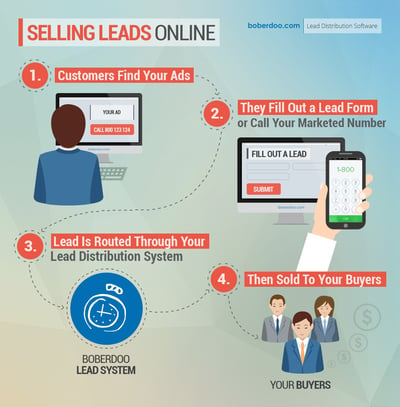
Selling leads online presents numerous growth opportunities. For one, the industry is growing rapidly, and customers continue to fill out forms and call 800 numbers at a high rate. There are more leads out there than ever before.
Additionally, the software that assists you in selling leads online continues to evolve. Sophisticated solutions such as boberdoo.com include advanced tracking tools that let you narrow down all your lead sources, optimize each campaign, and generate higher-quality, higher-value leads.
Where Do I Find Leads?
If you're serious about learning how to sell leads, you must also understand how to acquire them.
Generate Your Own Leads
Generated leads are, quite simply, any of the leads you generate yourself, and there are plenty of avenues to start producing your own leads. The most common is using a landing page with an information form that interested consumers can fill out with their contact information. Advertising these landing pages on search engines, display networks, and other high-traffic media can produce more than enough leads for you. In addition, finding leads on social media is getting easier every day. Meta's Lead Ads can capture contact information in just a few clicks, pre-populating your forms with their user data.
Paid Leads
Another alternative for finding your leads is to buy them from other companies to resell, a process known as "arbitrage." Many lead generation companies are happy to find buyers for their leads, so simply getting in touch with whatever lead generation companies you find on a Google search will most likely result in you finding leads. On one hand, this process is much easier than generating your own leads, but of course, it can cost more than an advertising budget for your own generated leads.
Ultimately, finding leads comes down to budgeting yourself well. You gotta spend money to make money, right? If generating your own, make sure you know how much you can spend on your advertising budget, and if you're going the paid route, make sure you've done the research on how much your leads tend to profit you.
Where Do I Find Lead Buyers?
What's the point of having leads without buyers? And how will you buy leads without connections? Well, there are a couple of options:
LinkedIn is one of the best platforms for networking with lead buyers and sellers. Industry groups often contain active discussions and opportunities.
Trade Publications & Blogs
Many B2B marketing publications and company blogs host engaged communities of buyers and sellers. Participating in discussions helps build relationships.
Conferences
Events like LeadsCon or Lead Generation World are ideal for networking. These conferences gather serious players in the lead generation space and can accelerate partnerships.
How boberdoo Can Help
To run a successful lead-selling business, lead companies need either to build or purchase a lead distribution system to handle these tasks. While we have worked with many companies that have attempted to build their own proprietary lead distribution systems, we have also quickly shown them how much cheaper and more efficient it is to use a 3rd-party system such as boberdoo.
Not only does a 3rd-party system save you from hiring an IT staff to build and maintain one, but companies such as boberdoo bring you nearly two decades of knowledge in the lead generation industry. In boberdoo’s case, this knowledge and experience have led to new features and improvements constantly added to the boberdoo lead distribution system, giving every lead seller not only the best lead distribution technology but also additional opportunities to maximize their lead revenue and optimize their lead flow.
Want to see boberdoo in action? Book a meeting or call us at 800-776-5646 to get started.