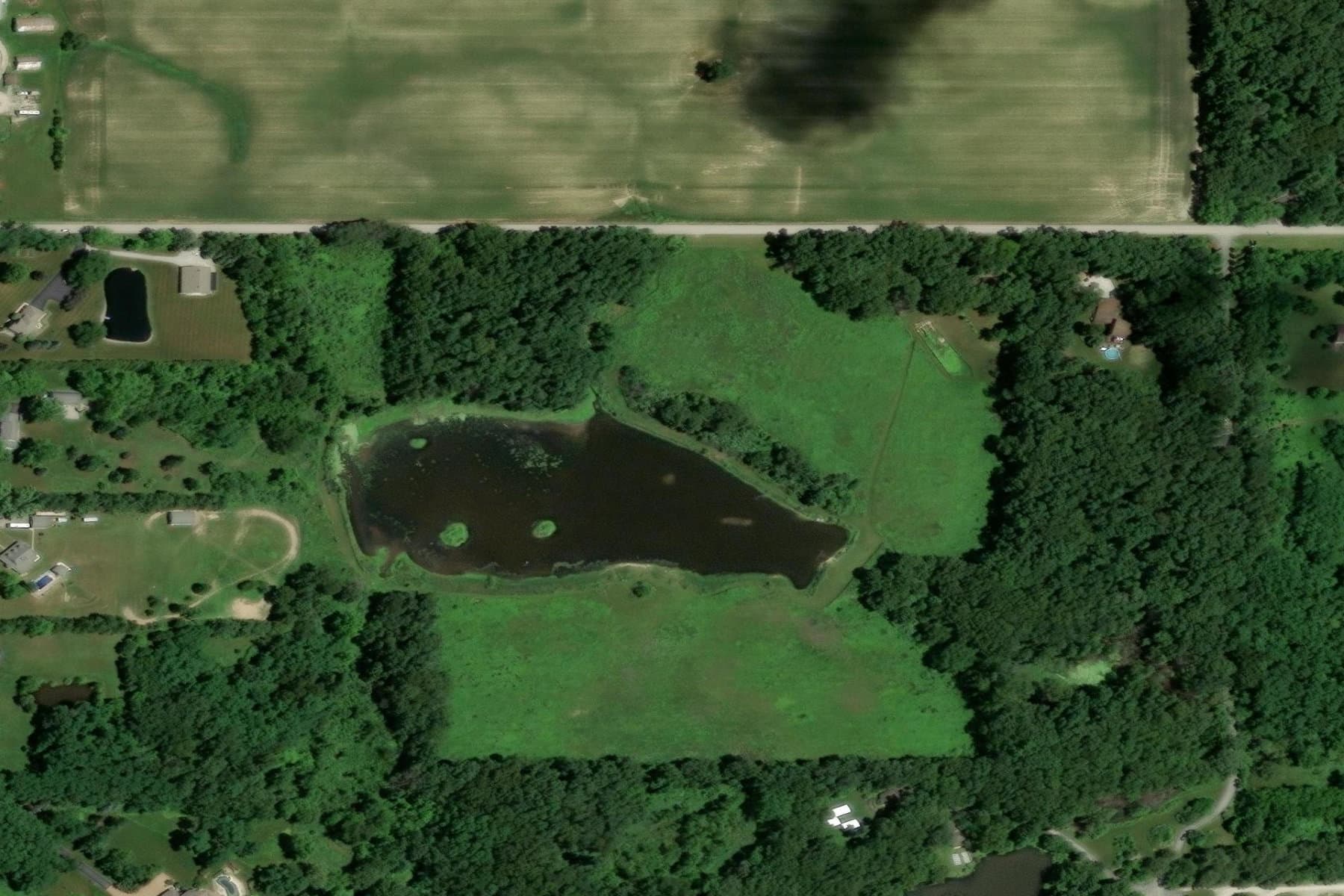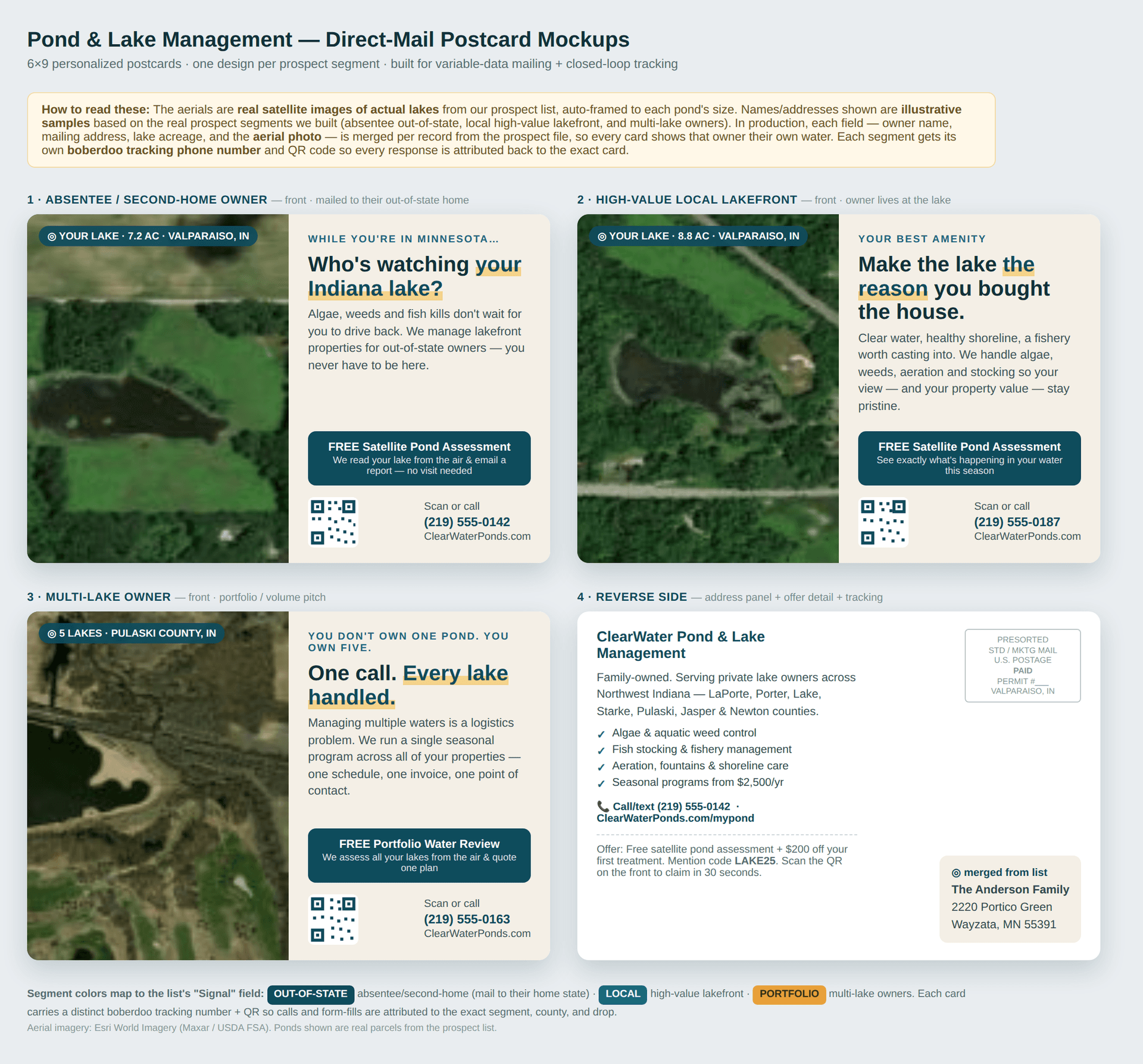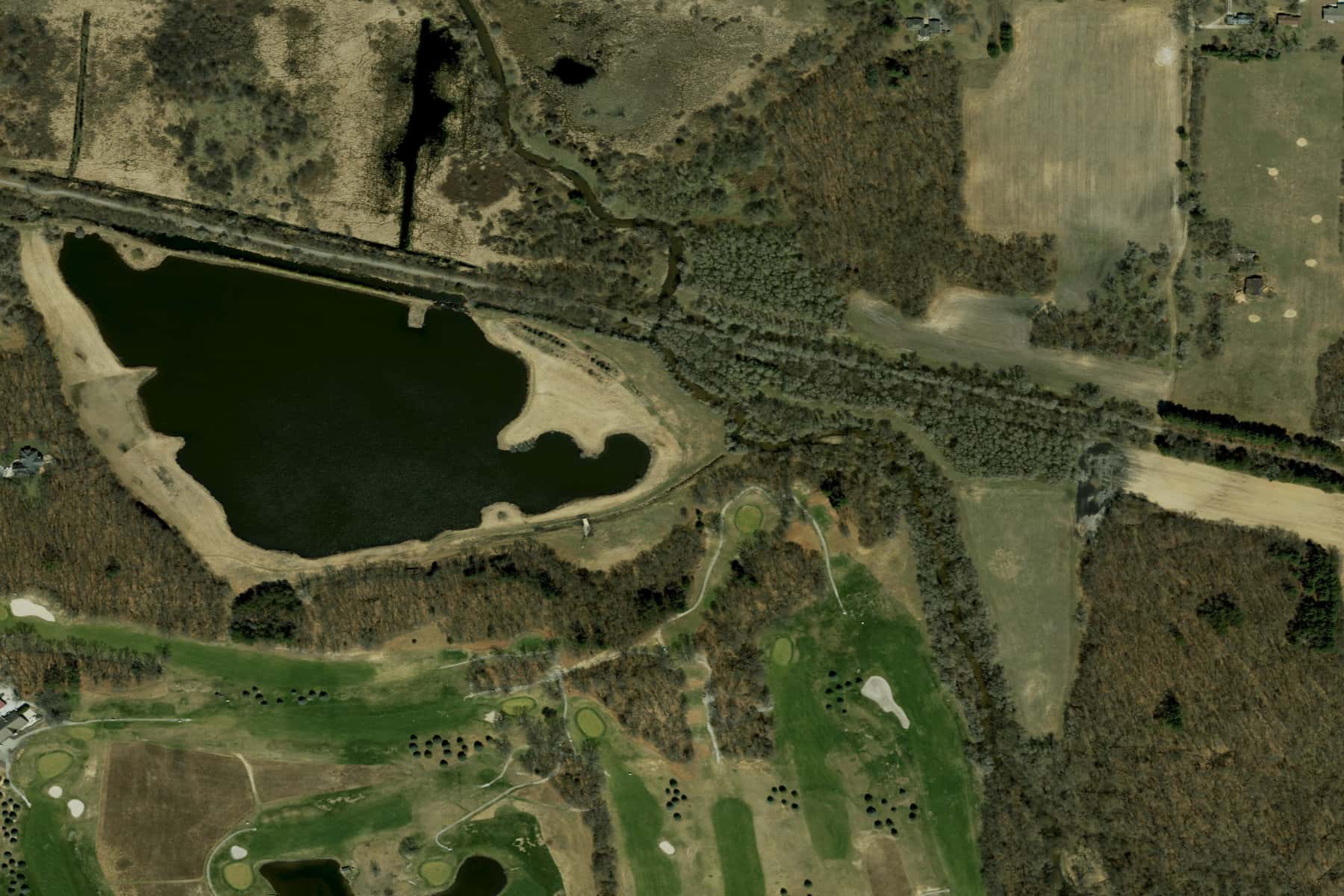
Part 3 of our series on AI-powered, top-of-funnel lead generation for service businesses. Part 1 mapped 2,427 lakes and built a 694-owner prospect list. Part 2 turned it into a self-tracking, personalized direct-mail campaign. Now we go where the mailbox can't reach — using that same first-party data to find and market to pond owners across a 75-mile radius, entirely online.
The list has a hard edge. The internet doesn't.
Our 694 named prospects live in seven counties where we could match a lake to a parcel to an owner. That's the mailable market. But the addressable market is far bigger — and we already own the one asset that lets us reach it: a tight, real-world profile of exactly who buys pond services.
So we set a center point — the shop's ZIP, 46531 (Grovertown, Starke County) — and a 75-mile service radius, and we go find everyone who looks like our best customers inside it. That circle is not random farmland. It encloses some of the densest private-lake geography in the Midwest:
- Kosciusko County — Indiana's "Lake Country" — has 100+ lakes, including Lake Wawasee, the largest natural lake in the state, ringed by high-value lakefront homes (~40 miles east).
- Southwest Michigan (Berrien, Cass, St. Joseph, Van Buren) — hundreds of natural inland lakes (~30–70 miles north).
- The affluent lake exurbs toward Chicago and the Fox / Chain O'Lakes area to the northwest.
- Plus the original NW Indiana seven-county base where the mailable list already lives.
Conservatively, that's several thousand private ponds and lakes inside one drivable circle. Direct mail reaches the 694 we can name; the tactics below reach the rest — and re-touch the 694 for good measure.
The spine: one destination, everything measured
Before a dollar of ad spend, lock the measurement in, or you're buying guesses again. Every online channel points to one place — the "Free Satellite Pond Assessment" landing page from Part 2 — and every channel is tagged so you can compare them honestly:
- A unique boberdoo tracking number per channel (Facebook, Google Search, Local Services, YouTube), each with call recording and IVR ZIP-capture, so an inbound call is attributed to the channel and the caller's location before you say hello.
- A distinct UTM per channel/creative on the landing-page URL, with the form posting into boberdoo so web leads and phone leads sit in one dashboard.
- A conversion pixel (Meta Pixel + Google tag) firing on the assessment form's "thank you," so the ad platforms optimize toward booked assessments, not clicks.
Now every tactic below reports a real cost per booked assessment by channel and geography. That's the number that decides where month two's budget goes.
Channel 1 — Meta (Facebook + Instagram): your scale engine
Three stacked audiences, in priority order:
1a. Custom Audience from the list (the warm core).
Upload the hashed name + mailing address of all 694 owners. Mailing address is a valid Meta identifier — but email and phone match at higher rates, so a name-and-address list matches a smaller share; treat any match rate as a number to measure, not assume (email-only lists commonly land ~40–60%; address-only runs lower). Even a couple hundred matched accounts clears Meta's ~100-person minimum to build a Custom Audience. It's a tiny audience, so run it at high frequency for low spend (~$5–8/day) with a "surround-sound" message that reinforces the postcard — mail-plus-digital together lifts response over either alone.
- Creative: the satellite angle. Primary text: "We noticed the lake on your property. Curious what's really going on under the surface? Get a free satellite pond assessment — no visit required." CTA: Get My Free Assessment.
1b. Lookalike Audience (the growth engine).
Build a 1–3% Lookalike off that Custom Audience, then hard-constrain the geography to a 75-mile radius of 46531 (Meta lets you drop a pin + radius). This tells Meta: find me tens of thousands more people who resemble proven lake owners, but only near the shop. This is where volume comes from. One honest caveat: a few-hundred-person seed sits below Meta's recommended 1,000–5,000 for a strong Lookalike, so expect rougher modeling at first — and strengthen the seed over time by folding in pixel converters and the appended contacts below.
1c. Interest + behavior layer (the cold net).
Same 75-mile radius, targeting homeowners with interests/behaviors like bass fishing, fly fishing, boating, waterfront property, Ducks Unlimited, tractor / rural-landowner, filtered to higher household-income and likely-to-own-acreage segments.
- Formats: a before/after pond-transformation carousel (green scum → clear water) and a 15-second video of a stocking-day bucket of bluegill hitting the water. Use Meta Instant Forms (native lead ads) that pre-fill name/email — piped straight into boberdoo — for the lowest-friction capture.
Starting budget: ~$600–900/month, split roughly 15% / 55% / 30% across 1a / 1b / 1c, then reallocated toward whichever posts the lowest cost-per-assessment.
Channel 2 — Google: catch the people already searching
2a. Google Local Services Ads (LSA) — do this first. LSA sits above the regular ads, is pay-per-lead, and carries the "Google Guaranteed" badge. Set the service area to the towns/counties inside the radius. It's the highest-intent, lowest-effort inbound source for "someone whose pond is a problem right now."
2b. Google Search Ads. Geo-target the 75-mile radius of 46531 and bid on problem-first and service-first keywords:
- "pond algae control near me," "how to get rid of pond weeds," "pond aeration [town]," "fish stocking Indiana / Michigan," "pond management company," "muck removal pond," "how many fish to stock per acre," "electrofishing pond survey," "largemouth bass stocking."
- Ad copy: Headline: Private Pond & Lake Management — Free Satellite Assessment. Description: Algae, weeds, aeration & trophy fish stocking across NW Indiana & SW Michigan. See your pond from the air — book free.
2c. YouTube (geo-targeted). Run the stocking-day and transformation videos as pre-roll on fishing, homesteading, and "pond" content within the radius. Cheap awareness that also builds the retargeting pool.
2d. Performance Max / retargeting to re-serve QR-scanners and site visitors across Google's inventory.
Starting budget: LSA ~$300–500/mo (pay-per-lead) + Search ~$500–800/mo.
Channel 3 — Retargeting & geo-fencing (precision)
- Retarget every QR-scanner and landing-page visitor who didn't convert, across Meta + Google Display + YouTube. These are your cheapest conversions.
- Geo-fence high-signal physical locations inside the radius — public boat launches, marinas, bait-and-tackle shops, farm-and-fleet stores, lake-association clubhouses — and serve display/CTV ads to devices seen there. A pond owner buying minnows at the bait shop is about as qualified as top-of-funnel gets.
Channel 4 — Local SEO & organic (the compounding asset)
Paid stops when the card gets declined; SEO keeps working. Build it deliberately:
- Google Business Profile optimized for pond management / lake management / pond aeration / fish stocking, with the service-area towns listed and stocking-day photos posted weekly.
- Programmatic location + service pages — one page per meaningful town/county in the radius: "Pond Management in Kosciusko County, IN," "Pond Aeration Near Warsaw & Lake Wawasee," "Fish Stocking in Berrien County, MI" — each linking to the assessment page. This is exactly the hyperlocal footprint that ranks for "[service] near me."
- Content that answers what owners Google — "How many bluegill and bass should I stock per acre?", "Why is my pond green and how do I fix it?", "What does it cost to stock a 1-acre pond in Indiana?" These rank, earn trust, and — not coincidentally — set up the pricing conversation in Part 4.
- A YouTube channel of transformations, electrofishing surveys, and feeder installs — evergreen top-of-funnel that doubles as sales proof.
Channel 5 — Email & SMS (from a contact append)
Run the 694 (and any radius list you license) through a contact-append / skip-trace service to add emails and mobile numbers. Use them the compliant way:
- Match, don't blast — upload emails/phones as another Custom Audience seed on Meta (they match at higher rates than a postal address). On Google, Customer Match needs at least ~1,000 matched members before it can serve ads, so the 694 owners alone won't switch it on — it becomes viable once the append (plus a wider regional list) pushes matched members past that floor.
- SMS only with consent — the assessment form is where you earn it ("text me my report"). Then a short seasonal cadence: spring algae alert, fall stocking window.
- Treat cold email cautiously (CAN-SPAM + deliverability); its best use here is audience matching, not spray-and-pray.
Channel 6 — Community & partnerships (low cost, high trust)
- Nextdoor neighborhood sponsorships and local-deal posts inside the radius.
- Facebook Groups — lake-association pages ("Lake Wawasee residents," "[Lake] Property Owners"), Indiana/Michigan bass-fishing groups, rural-landowner groups. Show up with genuinely useful answers; offer sparingly.
- Referral / affiliate links with adjacent trades that already sell to lakefront owners — realtors listing lake homes, dock builders, well drillers, landscapers. A simple co-branded assessment link and a per-job referral fee turns their customers into yours.
A sample 90-day online plan
- Meta (custom / lookalike / interest) — Monthly budget: $600–900; Primary metric: Cost per booked assessment
- Google Search — Monthly budget: $500–800; Primary metric: Cost per booked assessment
- Google Local Services Ads — Monthly budget: $300–500; Primary metric: Cost per qualified lead
- YouTube + retargeting — Monthly budget: $200–400; Primary metric: Assisted conversions
- Geo-fencing (optional, mo. 2+) — Monthly budget: $300–500; Primary metric: Foot-traffic conversions
- Local SEO / content — Monthly budget: $300–600 (or in-house); Primary metric: Organic assessments
- Total — Monthly budget: ~$2,200–3,700/mo; Primary metric: Blended cost per assessment
Month 1 is a read: run everything small, watch the boberdoo dashboard, and find the two channels with the lowest cost per booked assessment. Month 2, cut the losers and double the winners. Month 3, expand the winning audience's radius or geography. The list from Part 1 seeds it all; the landing page and boberdoo tracking from Part 2 measure it all; and now the same customer profile that fit in a mailbox is working the entire 75-mile circle.
Coming in Part 4: let the pond owner build their own proposal
Everything so far drives to a single free assessment. Part 4 raises the ceiling — because not every pond owner wants the same thing, and the good ones don't flinch at a big number.
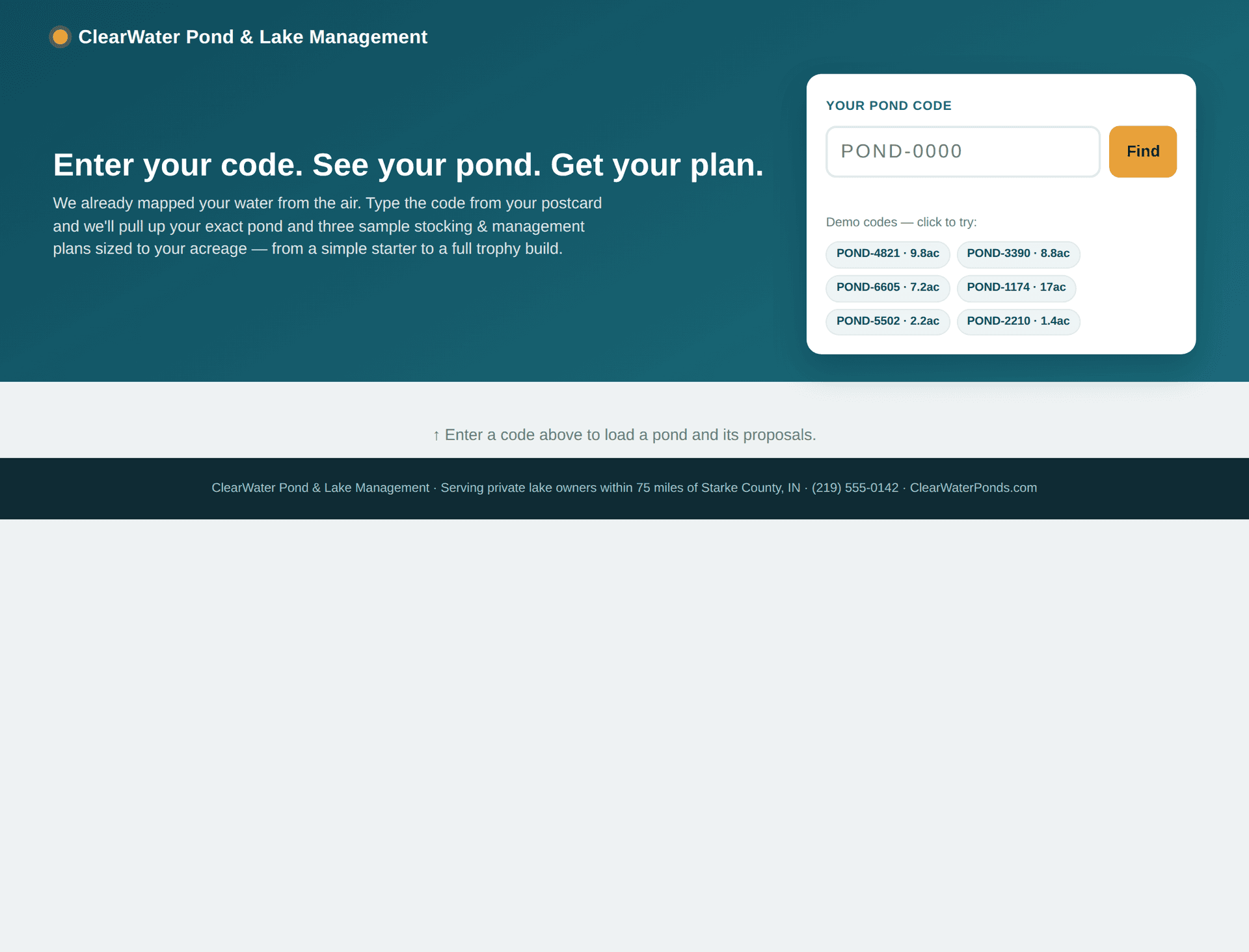
Here's the build: a personalized proposal website where an owner enters the code from their postcard, and the page loads their exact pond — the satellite image and acreage we already have on file — then generates tiered sample proposals scaled to their lake size. Same tool for a $1,500 buyer and a $15,000 buyer; the software just does the math per acre:
- Package 1 — "Balanced Water" (entry). Forage + panfish stocking sized to the acreage — fathead minnows as forage, plus bluegill and a starter bass ratio (industry rule of thumb is roughly 500 bluegill and 50–100 bass per acre, about 10:1 forage-to-predator). A clean, credible starting point.
- Package 2 — "Balanced + Sport" (most popular). A heavier forage base with golden shiners, added redear sunfish and channel catfish, and a first algae/weed treatment.
- Package 3 — "Trophy Package" (premium). The full program: an electrofishing pond-shock survey to read the existing fishery, trophy-strain largemouth bass, a properly sized aeration system (~1 HP per surface acre as a planning rule), 1–3 Texas Hunter fish feeders, bags of feed, and delivery/setup. This is the $10K–$15K+ proposal a serious lake owner will happily consider — because they can see their own pond attached to it.
The genius of it is self-selection: the same page shows a modest owner a modest plan and a trophy owner a trophy plan, and every interaction posts into boberdoo — so sales calls open with "I saw you were looking at the Trophy build for your 9-acre lake."
Part 1 built the list. Part 2 mailed it. Part 3 puts the same customer profile to work across a 75-mile radius online. Part 4 hands each owner a proposal with their own water on it — and lets them tell us how much they're ready to spend.
Budgets and audience figures are planning estimates for a single-market service business; confirm current ad-platform minimums and Local Services Ads availability for your categories and area. Stocking rates and aeration sizing are standard industry rules of thumb — final specs come from an on-site or electrofishing survey.