Part 2 of our series on AI-powered, top-of-funnel lead generation for service businesses. In Part 1, we used AI and public geospatial data to map 2,427 lakes and build a ranked, 694-owner prospect list for a pond management company — for essentially $0 in list costs. Now we spend the money where it counts: getting in front of those owners, and building a campaign that tells us exactly what worked.
The advantage most direct mail throws away
Direct mail still works. Widely cited industry data (ANA/DMA) puts response rates for a prospect — cold — list around 1%, and for a house list closer to 5%, both of which crush the roughly 0.1% you'd expect from a cold email blast. But almost everyone mailing a prospect list is mailing strangers they can only describe in aggregate: "homeowners in these ZIP codes."
We're not. Because of Part 1, we know, for every single one of our 694 prospects:
- their name and mailing address,
- the size of their lake in acres,
- whether they're local, absentee, or a second-home owner,
- a wealth signal — in Porter County, the actual assessed value of their home — and
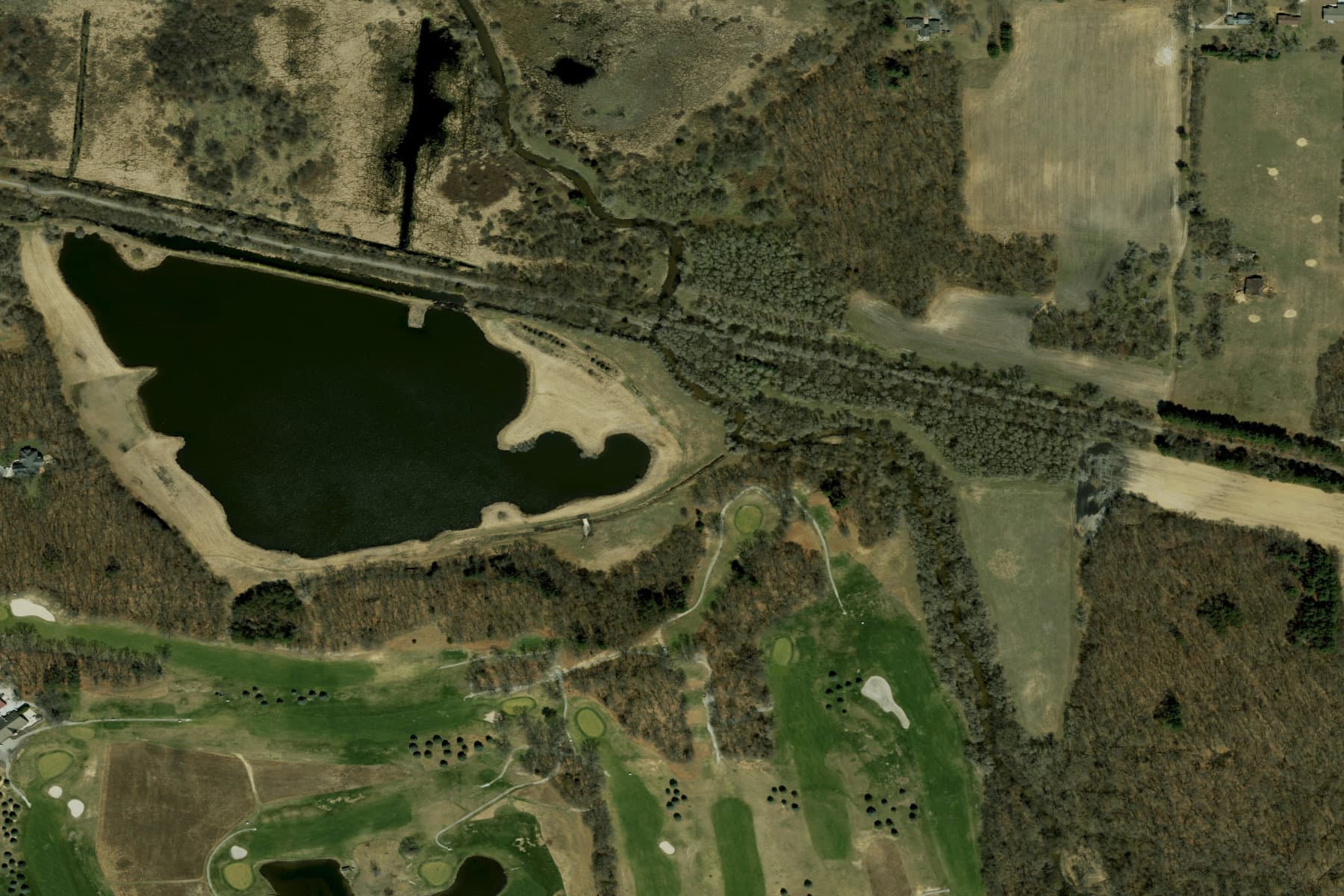
- a satellite image of their exact pond.
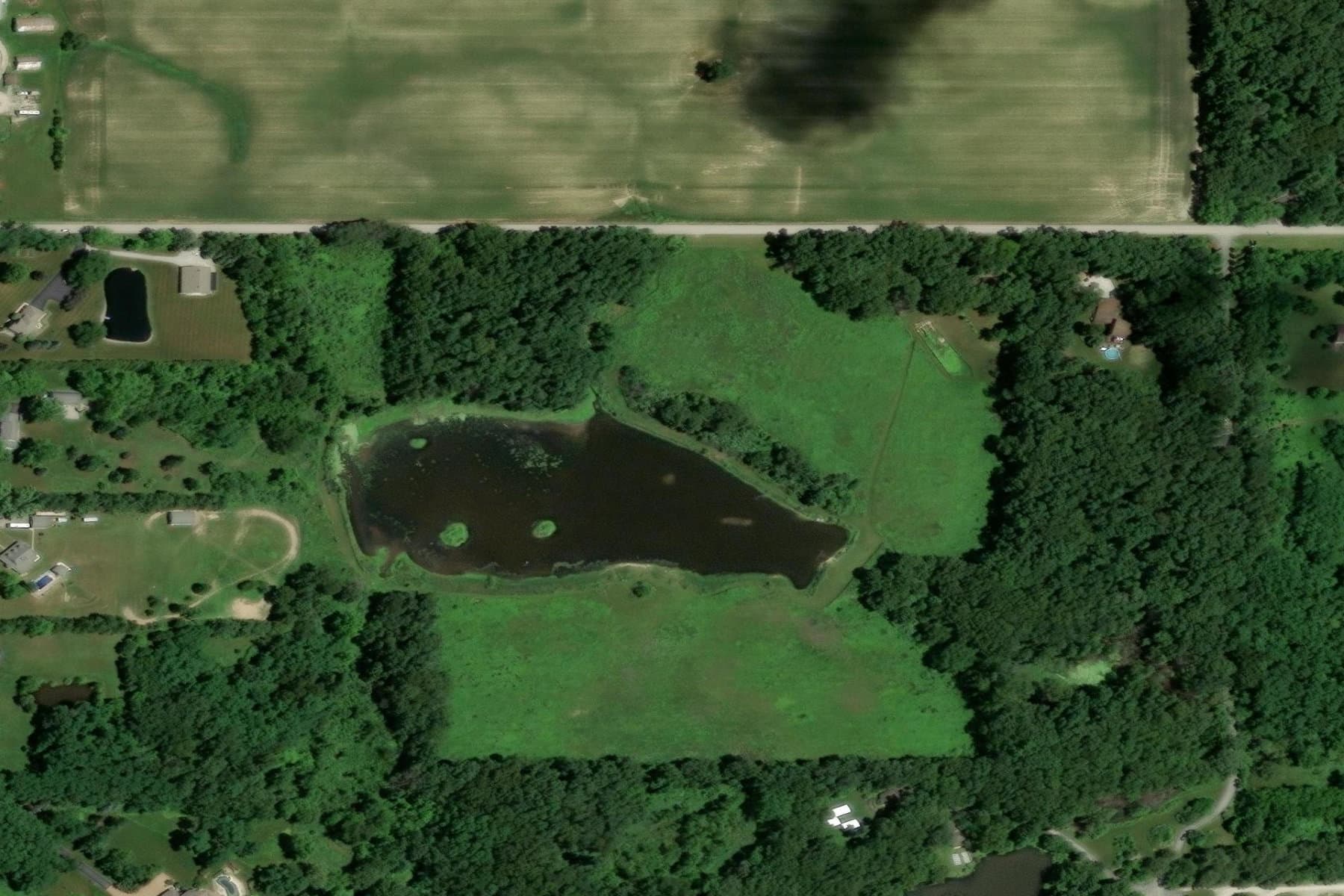
That last one changes everything. The single highest-leverage direct-mail play available to this business is a postcard that shows the owner an aerial photo of their water under a headline like "We noticed your 8.8-acre lake off Mander Road." Variable-data personalization like that typically lifts response 2–3× over a generic mailer — and we already have every field it needs.

The 8.8-acre lakefront property in Valparaiso behind that headline. Because Part 1 attached a satellite image and an acreage to every prospect, the postcard can show each owner their own water — not a stock photo of somebody else's. (Esri World Imagery / Maxar / USDA FSA.)
The hero asset: a personalized "your pond from above" postcard
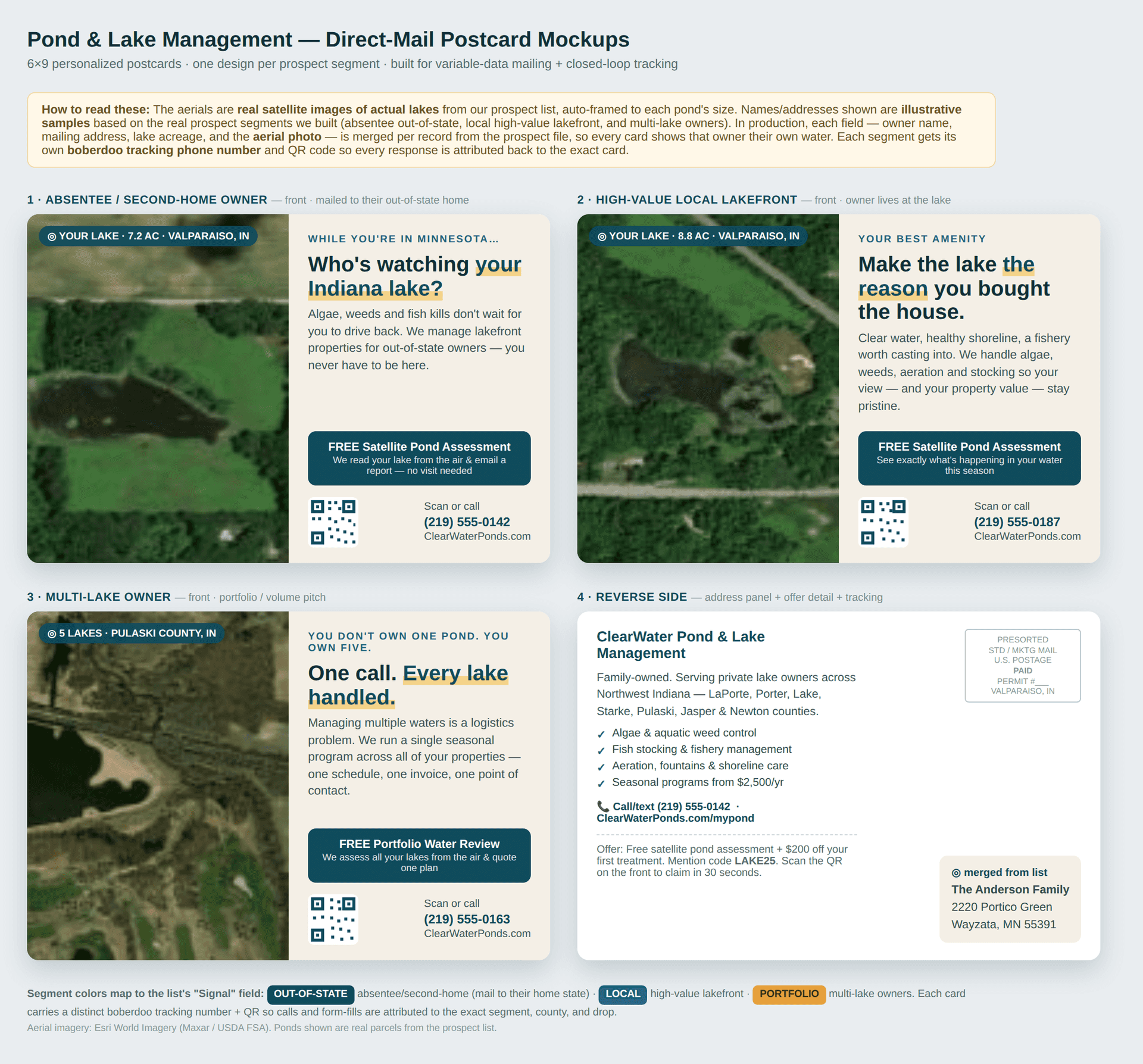
We built three postcard designs, one per segment (mockups below). The creative is deliberately different for each, because the reason to buy is different:
- Out-of-state / absentee — Who they are: Owner mails in from another state — we found owners in Minnesota, Florida, Arizona, and Illinois holding Indiana lakes; The hook: "While you're in Minnesota, who's watching your Indiana lake?" — a done-for-you, remote-managed service
- Local high-value lakefront — Who they are: Lives at the lake; in Porter County these are homes assessed $700K–$1.25M; The hook: "Make the lake the reason you bought the house." — aesthetics, fishery, property value
- Multi-lake owner — Who they are: Holds several lakes — one Pulaski trust owns five; several Starke owners hold two or three; The hook: "One call. Every lake handled." — a single portfolio contract
Every card carries the same two response mechanisms: a QR code and a unique tracking phone number (more on why that matters below). The offer is a low-friction lead magnet — a Free Satellite Pond Assessment — leaning on the same aerial imagery, so the mail piece and the landing page feel like one experience.

Three 6×9 postcard designs — one per prospect segment (absentee/second-home, local high-value lakefront, and multi-lake owner). Each shows the owner a real satellite image of their water and carries its own tracking number and QR code. Sample names are illustrative.
What it actually costs (2026 planning numbers)
Here's the part that makes this strategy almost unfair. Based on 2026 direct-mail pricing:
- A 6×9 postcard — the format with the best response rates — runs $0.65–$1.00 per piece all-in (print + postage + mailing at automation / Marketing Mail rates).
- Adding a variable satellite image to each piece adds $0.05–$0.15, and variable text (their name, their acreage) is usually free to a few cents.
- Call it ~$0.80–$1.15 per fully personalized piece.
Run the math on our list:
- A-list only (top-scored across counties) — Pieces: ~120; ~Cost/piece: $1.00; Total: ~$120
- Full delivered list — Pieces: 694; ~Cost/piece: $0.95; Total: ~$660
- Full list, 3-touch sequence (spring / early summer / fall) — Pieces: 2,082; ~Cost/piece: $0.95; Total: ~$1,980
Now weigh that against the prize. This company's target customer spends more than $2,500 a year, and pond management is a recurring, multi-year relationship. At a conservative 2% response on 694 pieces, that's ~14 conversations; even if only half close, that's ~7 new recurring accounts worth $17,500+ in year-one revenue — against a ~$660 mail cost. The list was free. The mail is the price of a single service call. Very few lead-generation channels post numbers like that.
A note on EDDM. For the dense community-lake pockets — the subdivision and association lakes we set aside in Part 1 — a saturation tool like USPS Every Door Direct Mail is worth a second look. EDDM postage is just $0.247/piece (roughly $0.32–$0.41 all-in), but it mails every address on a carrier route, so you lose the personalization. Use targeted, personalized mail for the 694 single-owner prospects; use EDDM only to blanket a neighborhood where you already know there's a shared lake and an HOA to pitch.
Who prints and mails it: a quick provider comparison
You don't need to build a print shop. The market splits into a few lanes:
- Postalytics — Best for: Small, targeted lists that need built-in tracking; Personalization / variable image: Strong — variable data, PURLs, QR, delivery + response tracking baked in; Roughly: ~$0.65–$1.20/pc
- PostcardMania — Best for: Full-service, done-for-you (design + list hygiene + print + mail + reporting); Personalization / variable image: Yes, with account management; Roughly: Higher touch, quote-based
- Lob / PostGrid — Best for: Developers automating mail via API at scale; Personalization / variable image: Excellent — conditional logic, variable images; Roughly: Volume / API pricing
- Taradel — Best for: Mixing targeted drops with EDDM saturation; Personalization / variable image: Limited on targeted; great EDDM marketplace; Roughly: Low, self-serve
- Vistaprint / local printer — Best for: Cheapest printing if you'll handle mailing yourself; Personalization / variable image: DIY, no tracking; Roughly: Print-only
For a campaign this size — hundreds, not hundreds of thousands — that lives or dies on personalization and tracking, Postalytics is the natural fit for a hands-on owner, and PostcardMania if you'd rather hand the whole thing off. Either way, feed them the prospect file from Part 1 — it's already formatted with names, addresses, acreage, and satellite links.
The part everyone skips: make the campaign track itself
Here's where this stops being "mailing postcards" and starts being lead generation you can optimize. A mailer you can't measure is a guess you paid for. So before a single card goes out, every response path gets instrumented — a natural place to put boberdoo to work, since it's built to capture and attribute inbound leads:
- A unique tracking phone number per segment (and per county/drop). Order numbers inside the platform and route incoming calls into campaigns. Put a different number on the absentee card, the local card, and the multi-lake card. When the phone rings, you already know which postcard and which market produced that call — plus call recording for coaching and an IVR that can capture the caller's ZIP from the keypad for instant routing.
- A QR code → landing page → form that posts into the same system. boberdoo handles inbound web-form leads with the same business rules as calls, so your postcard calls and your "Free Assessment" form-fills land in one dashboard, not two silos.
- Real-time attribution. The platform reports call volume, duration, conversion rates, and — critically — which source generated the most leads. After the first drop you'll know whether the absentee message out-pulls the luxury message, whether Porter beats Lake, and your true cost per booked assessment by segment.
That closed loop is the whole point. Drop one becomes a controlled test; drop two spends more on the segment and county that actually converted. You're not "doing direct mail" anymore — you're running an optimizing acquisition channel with a feedback signal.
The landing page that ties it all together
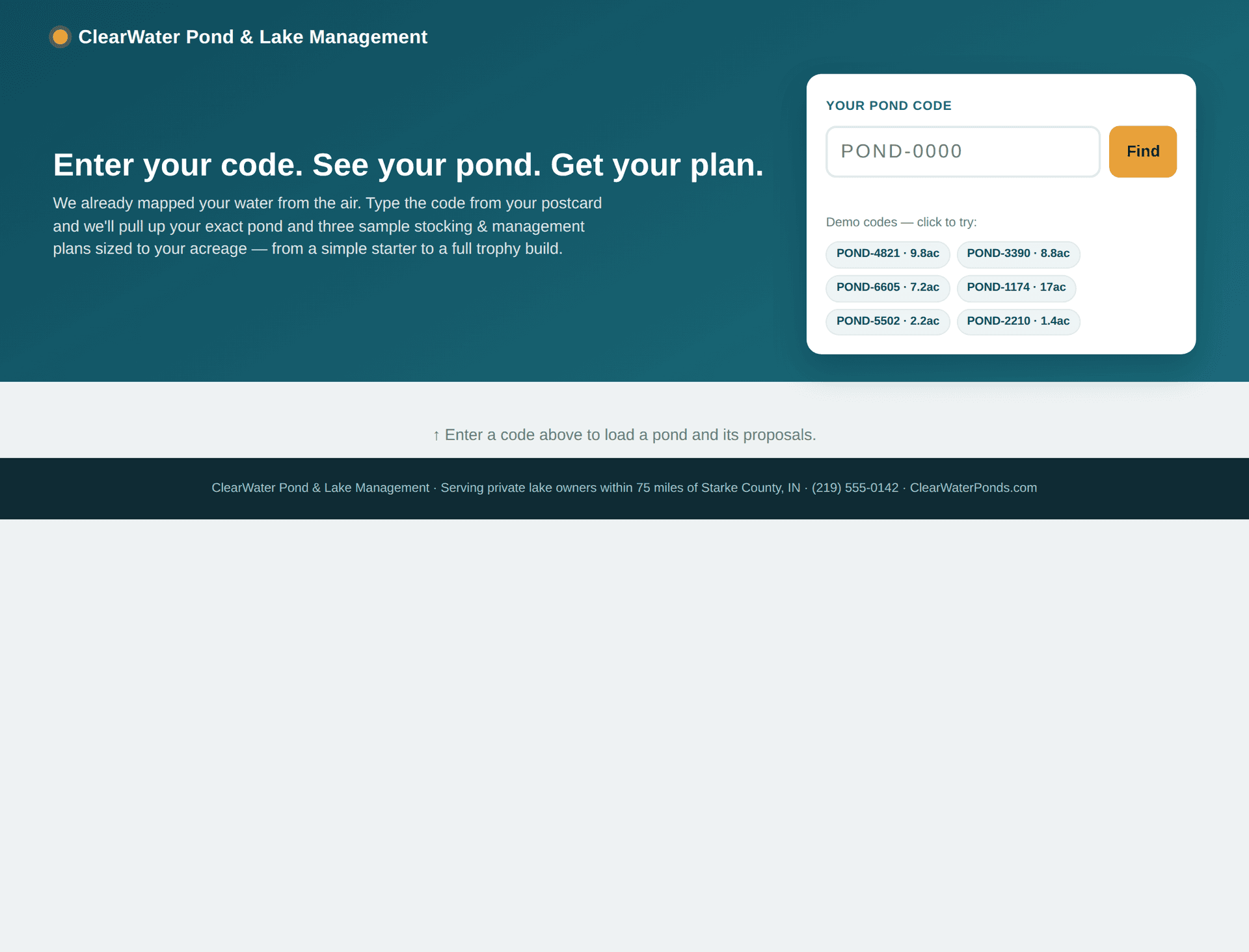
The QR codes and tracking numbers point to one destination: a "Free Satellite Pond Assessment" landing page (e.g., ClearWaterPonds.com/mypond). It should do four things:
- Mirror the mail piece — same aerial-photo aesthetic, same headline, so the scan-to-page handoff feels seamless.
- Ask almost nothing — name, property address (pre-filled via a personalized URL when possible), lake size, and one qualifying question: "What's your #1 frustration with your pond?"
- Post every submission into boberdoo so web leads are scored, attributed, and routed exactly like calls.
- Set up the offer — the free aerial assessment plus a first-treatment incentive (our mockups use "$200 off, code LAKE25").
This page isn't just for the mail campaign. It's the conversion hub for every channel — which is exactly why it carries straight into Part 3.
Coming in Part 3: finding these owners online
Offline gets you to the 694 people whose mailboxes we know. Part 3 flips the funnel and goes digital — using the same first-party data to find and re-touch these owners (and people just like them) on screens:
- Custom Audiences from the list. Upload the hashed list — name and mailing address are both valid match identifiers — to Meta to serve ads to the exact owners we mailed, a coordinated mail-plus-digital "surround sound" that lifts response over either channel alone. (Google's Customer Match needs ~1,000+ matched members to activate, so at 694 it waits until the list grows or gets email/phone-appended — more in Part 3.)
- Lookalike / similar audiences. Let the platforms find thousands more people who resemble our proven lake owners — turning a finite list into an ongoing top-of-funnel engine.
- Retargeting everyone who scans a QR or lands on the assessment page but doesn't convert.
- Contact-append / skip tracing to add emails and mobile numbers, unlocking compliant email and SMS follow-up.
- Local SEO + Google Local Services Ads to capture the "pond service near me" demand the mail campaign stirs up.
In Part 1, AI built the list. In Part 2, we turned it into a personalized, self-measuring direct-mail machine for the price of a service call. In Part 3, we make the internet find the rest of them.
Pricing and response-rate figures reflect 2026 USPS and commercial direct-mail rates and widely cited industry benchmarks (ANA/DMA); treat them as planning guidance and confirm current quotes with your chosen provider. Owner details are drawn in aggregate from public property records; sample names on the mockups are illustrative. Aerial imagery: Esri World Imagery (Maxar / USDA FSA).