Part 4 of our series on AI-powered, top-of-funnel lead generation for service businesses. Part 1 built a 694-owner prospect list from public geospatial data. Part 2 mailed it with personalized, self-tracking postcards. Part 3 put the same customer profile to work online across a 75-mile radius. This is the last mile — and the highest-leverage one.
One free offer, two very different customers
Everything up to now funnels to a single call to action: a Free Satellite Pond Assessment. It's a great offer. It's also a blunt one, because it treats a 1.4-acre backyard pond and a 17-acre trophy lake exactly the same.
They are not the same customer. Some owners want $1,500 of fish and to be left alone. Others won't scoff at a $15,000 build — an electrofishing survey, trophy-strain bass, aeration, feeders, the works — and would be mildly insulted to be handed the starter plan. A single flat offer either underserves the serious buyer or overwhelms the casual one. And you don't find out which is which until a salesperson has already spent a call guessing.
So the last piece of this system does the guessing for you. It lets the owner tell you how much they're ready to spend — before anyone picks up the phone.

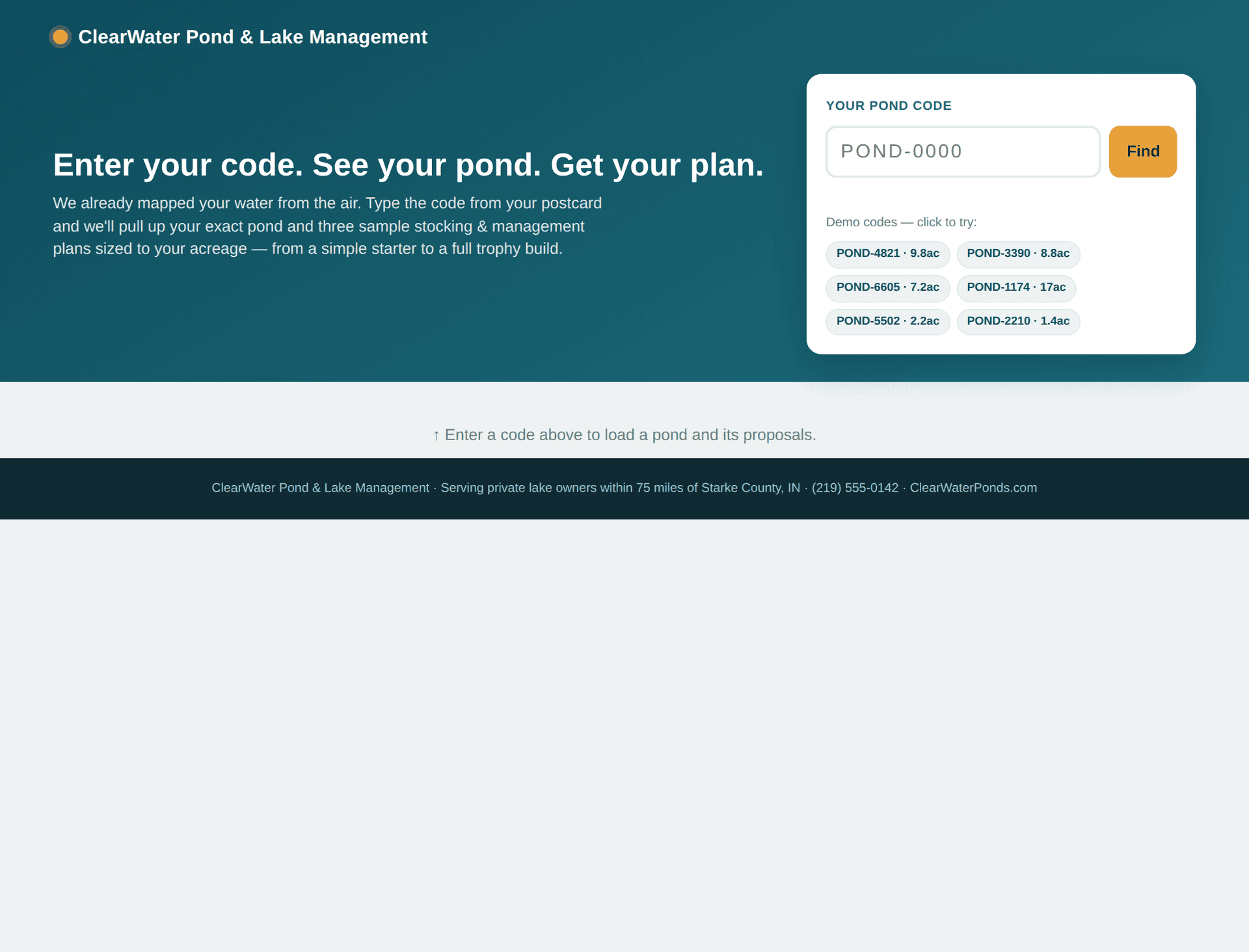
The personalized proposal tool: an owner enters the code from their postcard to pull up their exact pond. Everything behind that code — the satellite image, the acreage — came from the Part 1 data build.
The build: a proposal that assembles itself
The tool is a personalized proposal website. The owner enters the code printed on their postcard (or clicks through from the assessment page), and the site loads their pond — the satellite image and the acreage already on file from Part 1 — then generates three sample proposals scaled to that exact lake.
Nothing here is hand-built per owner. There's no analyst drawing up a custom quote overnight. The page does per-acre math on data the business already holds: acreage drives stocking counts, stocking counts drive cost, and the three tiers fall out automatically. A 2-acre pond and a 9.8-acre lake hit the same URL and see two completely different sets of numbers, because the software recalculates from the one field that matters most — surface acres.
That's the trick that makes this affordable at 694 prospects (or 6,940). Personalization at scale isn't manual effort; it's a formula applied to data you spent Part 1 collecting.
Walking the three tiers
The proposals follow the standard shape of a pond program, from a sensible starter to a genuine trophy build. The stocking and sizing numbers below are standard industry rules of thumb — the real specs always come from an on-site or electrofishing survey — but they're close enough to make a proposal an owner can act on.
Package 1 — "Balanced Water" (the starter). A forage-and-panfish base sized to the acreage: fathead minnows as the forage layer, bluegill, and a starter bass ratio. The working rule of thumb is roughly 500 bluegill and 50–100 bass per acre, about a 10:1 forage-to-predator balance. It's the credible entry point for an owner who mostly wants a healthy, good-looking pond.
Package 2 — "Balanced + Sport" (the most popular). Everything in the starter, tuned toward an actual fishery: a heavier forage base with golden shiners, added redear sunfish and channel catfish, and a first algae-and-weed treatment. This is the middle option most owners gravitate to — enough to fish seriously without committing to the full build.
Package 3 — "Trophy Package" (the premium). The complete program: an electrofishing pond-shock survey to read the existing fishery, a heavy forage base feeding trophy-strain largemouth bass, a properly sized aeration system (~1 HP per surface acre), one to three Texas Hunter fish feeders, bags of feed, and delivery and setup. This is the $10,000–$15,000-plus proposal a serious lake owner will happily read to the end — because their own water is sitting right at the top of it.
Here's what the tool actually produces for the 9.8-acre demo lake:

Three sample proposals auto-scaled to a 9.8-acre lake — Balanced Water ($4,046), Balanced + Sport ($7,792), and the Trophy Package ($20,726) — each attached to the owner's own satellite image. Sample pricing for illustration.
- 2.0-acre pond — Balanced Water: ~$1,025; Balanced + Sport: ~$1,906; Trophy Package: ~$7,874
- 9.8-acre lake (demo) — Balanced Water: $4,046; Balanced + Sport: $7,792; Trophy Package: $20,726
- 17-acre lake — Balanced Water: —; Balanced + Sport: —; Trophy Package: up to ~$32,950
Look at the spread. The same tool quotes a $1,025 starter to a small-pond owner and a $32,950 trophy build to someone with 17 acres — and every number is defensible, because it's the per-acre math applied to real acreage, not a figure a salesperson pulled out of the air. (These are sample figures; the live site drops in the client's actual costs and recalculates. Keep that caveat front and center.)
The mechanism: lead qualification by self-selection
Here's the part worth slowing down on. The page doesn't push anyone toward a tier. It shows all three, attached to the owner's own pond, and gets out of the way.
A modest owner looks at Balanced Water, nods, and books. A trophy owner scrolls straight past it to the $20,726 build and lingers there. No salesperson set that expectation. The buyer sorted themselves. That's the whole idea — lead qualification by self-selection. Instead of a rep spending the first ten minutes of every call trying to read budget and intent, the customer has already declared both by which proposal they spent time on.
It also quietly reframes the price. A $20,000 number in a cold sales pitch feels like a negotiation. The same number, next to a satellite photo of your lake, itemized into fish and aeration and feeders you can picture on your own water, feels like a plan. The personalization doesn't just lift response — it makes a big number legible.
Closing the loop with boberdoo
None of this would matter if the signal evaporated. It doesn't. Every interaction with the proposal tool — which code was entered, which pond loaded, which package the visitor lingered on or requested a callback for — posts into boberdoo, alongside the tracking-number calls from Part 2 and the assessment form-fills from Part 3.
So it all lands in one dashboard, fully attributed, and the sales call opens warm: "I saw you were looking at the Trophy build for your 9-acre lake — want me to walk you through it?" The rep isn't qualifying anymore. They're confirming a decision the customer has already started to make. That's a different, and much shorter, conversation.
Zooming back out: the last dividend of first-party data
Step back and the arc of the series is really one idea compounding. The same three fields that put an owner on the list in Part 1 — their pond, its acreage, their segment — mailed to them in Part 2, targeted them online in Part 3, and now, in Part 4, hand them a proposal with their own water on it. You collected that data once. It paid off four times.
And it generalizes past ponds, the same way the Part 1 method did. Any service business whose work scales with a measurable unit — solar by the kilowatt, roofing by the square, dock building by the linear foot, tree work by the acre — can let customers self-configure and self-qualify off first-party data exactly like this. If you can size the job from a number you already have, you can let the buyer build their own proposal and tell you their budget in the process.

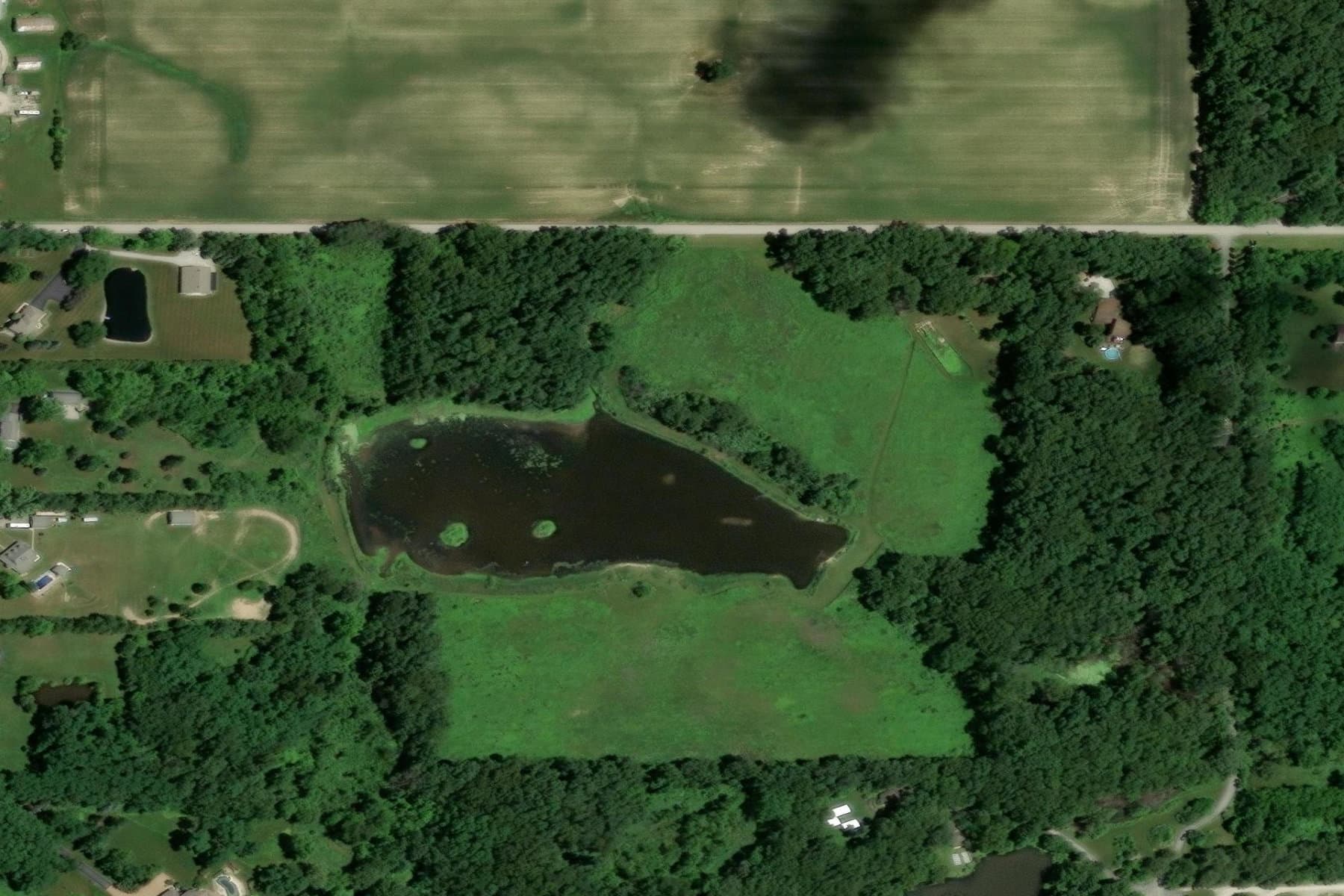
The demo's 9.8-acre lake in Valparaiso — the exact water an owner sees when they enter their code. "Their pond, their number" is the entire pitch. (Esri World Imagery / Maxar / USDA FSA.)
The whole system, in one line each
Part 1 built the list. AI mapped 2,427 lakes into 694 exclusive, ranked, first-party prospects for the cost of public-records access.
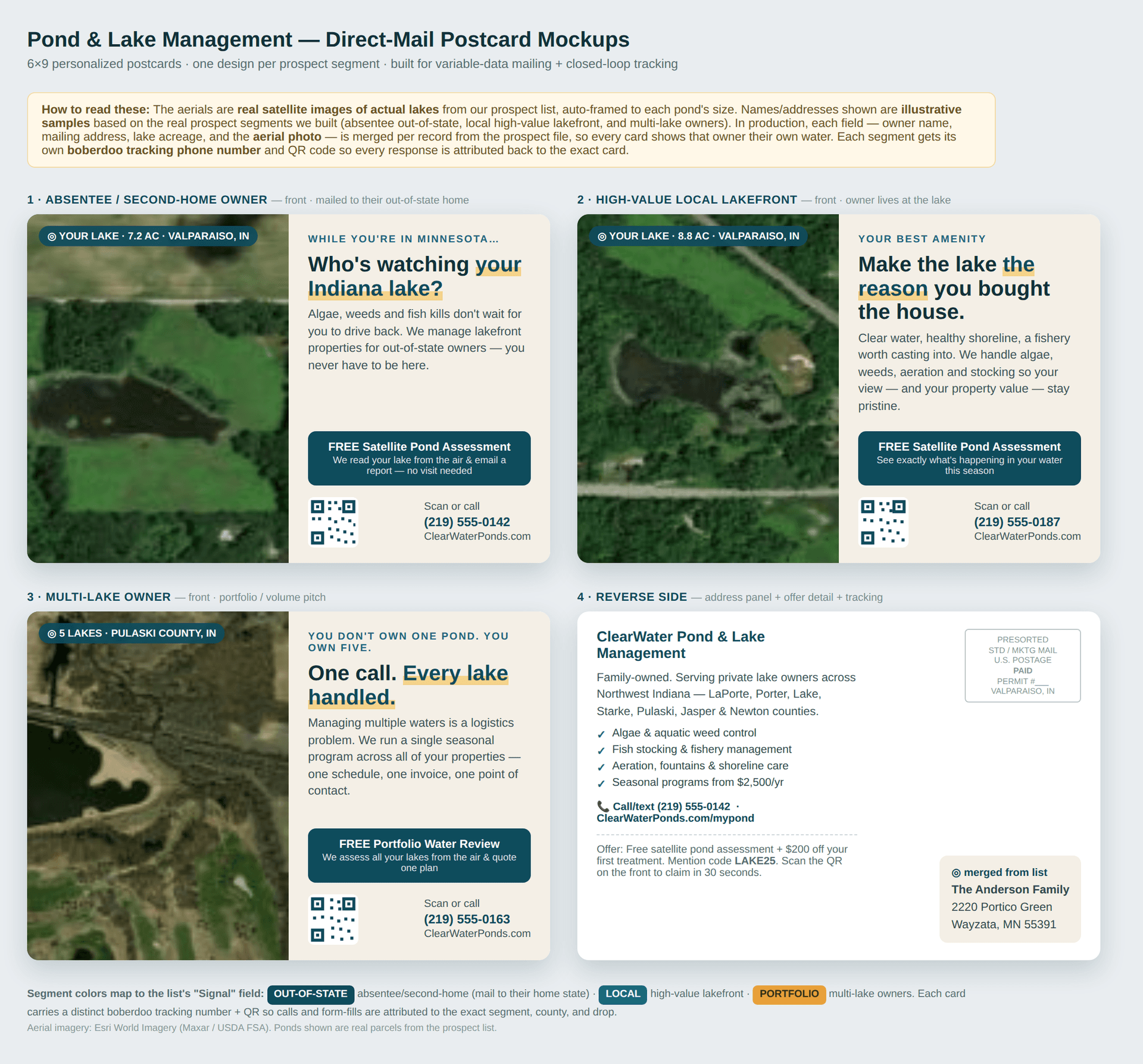
Part 2 mailed it. Personalized "your pond from above" postcards, split by segment, each one instrumented to track its own response.
Part 3 put the same customer profile to work online — custom audiences, lookalikes, local search, and geo-fencing across a 75-mile radius.
Part 4 handed each owner a proposal with their own water on it — and let them tell us how much they're ready to spend.
Every stage was measurable because every stage fed the same tracking-and-attribution layer. The list was the hard part, and AI did it in a day. Everything after was just spending into a signal — a phone number, a UTM, a proposal click — that told you, in real dollars per booked assessment, exactly where the next dollar should go. That's what turns a clever prospect list into an acquisition system you can actually run.
Pricing shown is sample pricing for illustration; the production tool uses the client's real costs and recalculates per pond. Stocking rates and aeration sizing are standard industry rules of thumb — final specs come from an on-site or electrofishing survey. Aerial imagery: Esri World Imagery (Maxar / USDA FSA).