
Ping Post Software - The Basics
Learning The Basics About Ping Post Software
In lead verticals like home improvement, auto finance and insurance, ping post software is standard operating procedure. But in other verticals like mortgage, student loan and legal offers, awareness of ping post software can vary greatly. This page covers some of the basics about ping post software and why it is important for the lead generation industry. If you are already familiar with ping post, you can explore more details on boberdoo.com's ping post platform here.
Ping post software is an application that allows for only partial lead information to be initially transmitted from the lead seller to the lead buyer, giving the lead buyer the opportunity to respond by either accepting or rejecting the lead. The primary benefit is the ability to protect information, both for the lead and the marketing assets of the lead generator. The ping post process protects the consumer's information by only sending the full contact information to the lead buyer that will actually service their needs. This protection of consumer information is good for the lead generation industry as a whole because the more self-regulation the industry can do itself, the less sweeping governmental regulations, like the recent TCPA changes, will go into effect. The protection of the company's assets, being the lead information itself, is also important because it allows lead generation companies to optimize its lead flow by distributing to companies that can actually service the lead.
While dynamic ping-post bidding represents the gold standard for high-volume lead monetization, enterprise lead brokers often combine it with fixed-price direct posting and priority buyer tiers. To understand where ping trees fit alongside round-robin and weighted routing, review the foundational methods of lead distribution used across the performance marketing industry.

What Is Ping Post?
Ping post is a lead distribution method that enables sellers to transmit partial lead information — known as the "ping" — to multiple potential buyers simultaneously. This partial data excludes personally identifiable information (PII), allowing buyers to assess the lead and determine their level of interest before committing to a purchase.
Once buyers evaluate the ping, they respond with a bid (or a rejection). The ping post system then collects all buyer responses and routes the complete lead details — the "post" — to the winning buyer or buyers based on predetermined distribution logic. This entire process is completed in real-time, typically within a matter of seconds.
The result is a distribution model that protects consumer privacy, gives buyers granular control over what they purchase, and allows sellers to maximize revenue through competitive bidding. For technical integration details, visit our ping post specifications. To learn about the return best price parameter, see our Return Best Price documentation.
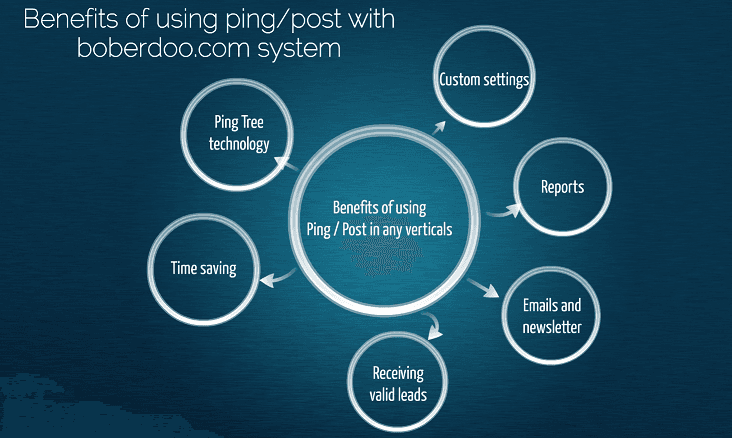
What Are The Benefits Of Ping Post?
Consumer Benefits
Ping post directly benefits consumers by minimizing the distribution of their contact information. Because only partial, non-PII data is shared during the ping phase, fewer companies receive full consumer details. This reduces the number of databases storing personal information and limits unwanted contact. By enabling competing service providers to evaluate leads without accessing sensitive data, ping post helps protect consumer privacy while still connecting them with relevant services.
Lead Buyer Benefits
For lead buyers, ping post provides enhanced control over purchasing decisions. Buyers can evaluate partial lead attributes — such as geography, project type, or coverage needs — and adjust their pricing based on the specific characteristics of each lead. This dynamic bidding capability improves cost-per-acquisition management and reduces time wasted on unqualified prospects. Instead of committing to purchase leads sight-unseen, buyers only pay for leads that match their criteria and budget.
Lead Seller Benefits
Lead sellers benefit from maximized revenue per lead through competitive bidding. Rather than selling at fixed prices negotiated weeks or months ago, sellers can let the market determine the true value of each lead in real-time. Ping post also protects the seller's most valuable asset — consumer contact information — by only releasing full details to the winning buyer. Additionally, the self-regulation inherent in ping post helps reduce the pressure for sweeping governmental regulations on the lead generation industry.
Who Uses Ping Post?
While there are many companies that may utilize ping post software, they primarily fall into two categories. The first category is agents/contractors/buyers who utilize ping post software to dynamically bid on leads based on internal custom rules. For example, a lead generator may ping an insurance agent with the zip code, email and whether the lead is a smoker. The agent can figure out the profitability of a lead with that profile and dynamically bid based on that profitability. Of course, ping post software runs through this process in real time so the agent develops custom rules for groups of leads that meet certain qualifications.
The second category of companies that utilize ping post software is lead resellers, also known as lead aggregators. Resellers specialize in setting up both buyer and seller relationships with multiple companies. They will use ping post software to receive pings from multiple lead sellers and send them to their various buyers to see if, and at what price, the lead can be sold. For example, a home improvement lead aggregator may receive the lead's zip code and project type and check its client list (also known as running it through a ping tree) for eligible buyers. If it does, the lead aggregator can respond to the original ping with a price. If there is no potential buyer, the lead will go to someone else.
What Are The Basics Of Ping Post?
At its core, ping post distributes partial lead information to potential buyers, allowing them to return dynamic bids. The ping post software collects all bids, sorts the responses (typically by price or priority), and automatically delivers the complete lead information to the winning buyer or buyers — all in real-time within seconds. For a deeper dive into the fundamentals, download our Basics of Ping Post whitepaper.
Definitions Of Ping Post
The ping post ecosystem has its own terminology that can be confusing for newcomers. Terms like ping, post, ping tree, scenario, dynamic bid, and static price each have specific meanings in the context of lead distribution. For a comprehensive glossary of ping post terms and their definitions, visit our Ping Post Definitions page.
The Basics Of Ping Post
New to ping post? Download our comprehensive whitepaper covering everything you need to know about ping post lead distribution — from foundational concepts to implementation strategies.
How Do You Buy Leads Via Ping Post?
Ping post transforms lead buying from a passive, fixed-price transaction into an active, data-driven strategy. Here is how boberdoo empowers lead buyers to optimize every dollar spent. Read more about buying ping post leads.
Performance-Based Bidding
The boberdoo system tracks conversion rates and customer lifetime value for each lead source, automatically adjusting bid offers based on actual performance metrics rather than assumptions. Poor-performing sources receive reduced investment before they can damage your ROI, while proven sources receive higher allocations.
Real-time performance adjustment responds to immediate quality indicators. If a source delivers multiple low-quality leads in succession, the system can automatically reduce bids without waiting for end-of-week reporting to surface the issue.
- Automatic bid adjustment based on historical conversion data
- Real-time source quality monitoring and response
- ROI protection through proactive poor-performer identification
Escape Fixed-Price Constraints
Dynamic bidding eliminates the artificial pricing equality of fixed-price agreements. Instead of paying the same amount for every lead regardless of quality or potential, buyers can compete based on their actual monetization capabilities. High-performing buyers gain access to better opportunities by bidding appropriately.
Budget optimization improves dramatically when allocation is based on expected returns rather than arbitrary fixed prices negotiated weeks or months ago. The market sets the true value of each lead in real-time.
- Eliminate stale pricing that no longer reflects market conditions
- Allocate budget based on expected return rather than flat rates
- Gain competitive advantage through smarter bidding strategies
Quality Vendor Prioritization
Automated vendor scoring considers multiple dimensions including conversion rates, lead quality, consistency, seasonal reliability, and growth potential. Rather than relying on a single metric, the system builds a holistic profile of each vendor's performance.
Investment allocation automatically reflects vendor rankings, ensuring top sources receive appropriate budgets while poor performers see reduced investment. Performance trending identifies vendors with improving or declining trajectories, enabling proactive relationship management before issues become costly.
- Multi-dimensional vendor scoring beyond simple conversion rates
- Automatic budget allocation based on vendor performance tiers
- Trend detection for proactive vendor relationship management
Build-Your-Own Lead Scoring
Custom scoring models allow buyers to define what constitutes a high-value lead based on their specific business requirements and historical performance data. Statistical analysis reveals which lead attributes are most predictive of conversion success for your particular operation.
As performance data accumulates, the scoring model continuously improves its accuracy, adapting to changing market conditions and buyer needs without requiring manual updates or recalibration.
- Define custom scoring criteria based on your unique business needs
- Statistical analysis reveals high-value lead attributes
- Continuous model improvement as performance data grows
Scale To New Vendors
Standardized vendor integration through boberdoo eliminates the technical scaling barriers that typically slow buyer growth. New vendors connect through a proven API that hundreds of partners already use, enabling rapid onboarding without substantial resource commitment.
Portfolio diversification becomes practical when adding a new vendor does not create operational complexity. Buyers can quickly test new relationships, evaluate performance, and scale investment in winning sources — all through the same familiar interface.
- Standardized API eliminates one-off vendor integrations
- Rapid onboarding enables quick relationship testing
- Portfolio diversification without operational overhead
How Do You Sell Leads Via Ping Post?
For lead sellers, ping post is the key to unlocking the full revenue potential of every lead. Here is how boberdoo helps sellers maximize the value of their lead inventory. Read more about selling ping post leads.
Maximize Revenue-Per-Consumer
The boberdoo system evaluates every possible monetization scenario before making a distribution decision. It compares exclusive versus shared distribution options, examines buyer performance history, and factors in current market conditions — all in milliseconds.
Scenario analysis automatically compares dozens of distribution combinations to select the optimal revenue path. For example, is it better to sell a lead exclusively to one buyer at $80, or distribute it to three non-exclusive buyers for a combined $110? The system makes that determination automatically for every single lead.
- Automatic exclusive vs. shared distribution optimization
- Real-time scenario comparison across all active buyers
- Dynamic market adjustment based on supply and demand conditions
Post Reject Optimization
When an initial buyer rejects a lead after the post, the boberdoo system does not simply fall back to a predetermined backup plan. Instead, it instantly recalculates optimal distribution scenarios considering the changed conditions and remaining buyer pool.
Secondary market opportunities often emerge when primary buyers decline for reasons that do not affect other buyers. Alternative monetization paths are evaluated in real-time, frequently recovering substantial additional revenue from leads that other systems would write off as losses.
- Instant recalculation after buyer rejections
- Fresh scenario analysis with remaining buyer pool
- Revenue recovery from leads other systems waste
Smart Margin Management
The system automatically adjusts margins based on vendor performance, relationship value, and current market conditions. Performance-based margin adjustments reward high-quality vendors with favorable terms while protecting profitability in inconsistent relationships.
Volume-based optimization offers margin incentives that promote vendor growth while ensuring profitability across all volume levels. Market condition adaptation adjusts margins dynamically based on supply and demand dynamics in specific verticals. Visit our ping post margins page for more details.
- Performance-based margin adjustments per vendor
- Volume incentives that scale with vendor growth
- Market-adaptive margin optimization by vertical
Reporting Suite
Real-time dashboards and detailed performance analytics support data-driven decision-making across your entire operation. Track metrics for every vendor, buyer, and lead type including conversion rates, revenue per lead, and customer lifetime values.
Financial reporting provides detailed profitability analysis considering all associated costs and revenue streams. Predictive analytics identify trends that enable proactive decision-making before issues impact your bottom line.
- Real-time dashboards for vendor and buyer performance
- Detailed financial reporting and profitability analysis
- Predictive analytics for proactive business decisions
Buyer Account Bidding
The boberdoo system implements nuanced distribution strategies that consider buyer performance, relationship value, and strategic factors — rather than a simple highest-bid-wins auction. Performance weighting adjusts effective bid values based on conversion rates and customer lifetime values.
Relationship value recognition considers factors beyond individual transaction values when evaluating bids. A buyer who consistently converts at high rates and maintains a long-term partnership may receive priority over a higher bidder with unreliable conversion history.
- Performance-weighted bid evaluation beyond raw price
- Relationship value factored into distribution decisions
- Strategic buyer prioritization for long-term profitability
What's The Difference Between Static And Dynamic Pricing?
In a ping post environment, there are two primary pricing models that can coexist within the same system.
**Dynamic Pricing** allows lead buyers to return different bid amounts in response to each ping. The bid amount can vary based on the specific attributes of the lead, current market conditions, the buyer's internal business rules, or any combination of factors. This is the core advantage of ping post — every lead is priced based on its actual value to the buyer.
**Static (Fixed) Pricing** is a traditional model where lead buyers agree to pay a fixed amount for any lead that meets their minimum qualifying criteria. For example, a mortgage broker may agree to pay a set price for any lead with a minimum loan value of $100,000, regardless of other attributes.
The boberdoo system supports both pricing models simultaneously. Sellers can compare dynamic buyer bids against fixed-price buyer agreements and automatically calculate the best revenue scenario for each individual lead. This flexibility ensures sellers can work with buyers at any level of ping post sophistication.
What Are Ping Post Scenarios?
When a ping post system receives multiple bids from buyers, it needs to determine the optimal distribution path. This is where scenarios come in. The boberdoo system automatically calculates the best revenue scenario by comparing exclusive buyer options against combinations of non-exclusive buyers, deducting profit margins, and returning the optimal represented bid to the seller.
If the initial winning buyer rejects the lead after the post, the system recalculates the next-best scenario using the remaining buyer pool. Distribution continues as long as the total revenue from the recalculated scenario exceeds the original bid that was returned to the seller. For a detailed walkthrough of how scenarios handle post rejects, visit our Ping Post Scenarios article.
Return Best Price Parameter
The Return Best Price parameter is a powerful feature for vendors integrating with the boberdoo ping post API. When vendors include the Return_Best_Price parameter with their source configuration, the system includes a calculated price in the ping response. This allows upstream sellers to factor the expected payout into their own distribution logic before committing to the post.
The specific calculation behind the returned price varies depending on your system configuration, active buyer bids, and margin settings. For full technical documentation, visit our Return Best Price Parameter page.
What About A/B Testing In A Ping Post Environment?
Ping post operates as a closed, single-bid process where buyers typically do not know the final selling price. This creates a unique optimization challenge: how do you determine the ideal bid amount without visibility into the competitive landscape?
The answer is Bid Experiments. boberdoo's Bid Experiments feature enables systematic A/B testing of lead bidding strategies. You can set up controlled tests for incoming pings to scientifically identify the optimal bidding prices for each lead type, source, or vertical. Rather than relying on gut instinct or static analysis, Bid Experiments let you discover the price point that maximizes your win rate while maintaining healthy margins.
Advanced Features Of Ping Post
Beyond the core ping-bid-post workflow, boberdoo offers a suite of advanced features designed to give operators complete control over their ping post environment. These include dynamic pricing configuration, bid experiments for A/B testing, duplicate lead checks, source and buyer fail-safes, margin management tools, and granular reporting.
For a comprehensive overview of all available configuration options and optimization strategies, visit our Ping Post Options page.
Ping Post FAQ
A ping tree is a lead seller's organized list of potential buyers that receive pings for each incoming lead. It is called a "tree" because each lead triggers multiple outgoing pings to different buyer branches. However, not all ping post solutions manage ping trees in the same way, so it is important to understand how your platform handles buyer prioritization and routing.
Home improvement, solar, auto finance, and insurance are the verticals where ping post adoption is most widespread. However, any vertical can technically utilize ping post, and adoption is growing rapidly in mortgage, financial services, legal, and subprime categories like tax debt and credit card debt settlement.
No. Ping post is a distribution process, not an anonymous lead exchange. Exchanges standardize contracts but quality can vary widely based on lead generation methods, sellers, and buyer sales processes. Establishing dedicated ping post networks with known partners maintains quality control and preserves the value of your supply chain.
Buyers must be able to dynamically return bids to participate in ping post. However, the boberdoo system supports mixed environments using scenarios. You can build static (fixed) price buyer combinations alongside dynamic bidders for each lead, selling to whatever combination yields the highest revenue from incoming pings.
Ping post specs are the technical instructions provided by lead buyers to sellers that enable the ping and post process. These specifications include the data fields required in the ping, response formats, and API endpoints. boberdoo clients provide their sellers with ping post specifications, source (SRC) values, and API keys for tracking and security.
Ping post margins can be calculated in various ways depending on whether you operate on the buyer side or the seller side of the transaction. boberdoo's standard process uses scenarios with margins residing on the seller side. For a detailed explanation, visit our ping post margins page.
Ping post works with live calls as well as web leads. For calls, sellers ping partial call information such as campaign details, IVR answers, and area codes. Buyers can then return both pricing and dynamic phone numbers (DIDs) for call routing if they win the bid.
There are two primary categories of ping post users. First, agents, contractors, and other lead buyers who dynamically bid on leads based on custom internal rules. Second, lead resellers and aggregators who receive pings from multiple sellers and distribute leads to various buyers for real-time pricing and matching.
Static pricing maintains a consistent cost for any lead meeting minimum qualifying criteria. Dynamic pricing includes variable price offers based on the highest bidding buyer minus margins, meaning the final price differs for each individual lead. The boberdoo system supports both models simultaneously.
boberdoo employs post-reject optimization, which recalculates the optimal distribution scenario using the remaining buyer pool and current market conditions. Rather than settling for a lower-paying backup option, the system conducts a fresh analysis that often recovers substantial additional revenue from rejected leads.
The core benefit is maximizing revenue per consumer through automatic scenario analysis. The system compares dozens of distribution combinations in milliseconds to select the optimal revenue path for every single lead, potentially generating hundreds to thousands in additional revenue over time.
Check Out Our Ping Post Blog
Stay up to date with the latest ping post strategies, feature updates, and industry insights on the boberdoo ping post blog.
Request A Demo
Interested in seeing how boberdoo ping post software can optimize your lead distribution? Fill out the form below and one of our experts will follow up with a personalized demonstration tailored to your specific requirements.